Best Akeneo Alternatives in 2026 (Top-Rated Solutions)
Looking for the best Akeneo alternatives? Compare Carro, Salsify, Plytix, and more on features, pricing, and use cases to find the right fit for your team.

Key Takeaways (TL;DR)
- Who Akeneo Is For: Akeneo is designed for mid-to-large enterprises that need a dedicated PIM to centralize, enrich, and distribute structured product data across multiple channels and markets.
- Why Seek an Akeneo Alternative: Akeneo's enterprise pricing starts around $40,000/year, the open-source version requires significant technical setup, and the platform focuses heavily on product data management rather than inventory-free catalog growth or dropship operations.
- Best for Inventory-Free Catalog Expansion: If your reason for evaluating Akeneo alternatives is that you need to grow your catalog not just manage it, Carro solves a problem no PIM on this list does. Our platform connects US-based retailers and marketplace operators to 1,500,000+ products from vetted brand partners, with automated order routing and real-time sync, and no inventory risk.
- What Sets Carro Apart: Carro is the only platform on this list built specifically for inventory-free catalog expansion through hand-matched supplier partnerships, automated order routing, and real-time sync across major eCommerce platforms.
- How to Choose: Consider three main factors: your business model (are you managing internal product data or expanding catalog through external partners?); your technical resources (can you support an open-source deployment or enterprise implementation?); and your growth stage (PIM tools like Akeneo serve mature catalog operations, while Carro serves retailers actively growing through distributed supplier networks).
Top Akeneo Alternatives in 2026 at a Glance
| Tool | Best For | Key Features | Pros | Cons | Pricing |
|---|---|---|---|---|---|
| Carro | Inventory-free catalog expansion for retailers and marketplaces | Hand-matched supplier network, automated order routing, real-time sync, pre-built integrations | No inventory risk; fast time to market; pre-built integrations | Not a traditional PIM; focused on dropship and marketplace models | 5% of sales (Standard) |
| Salsify | Enterprise brand manufacturers focused on the digital shelf | PXM + syndication, retailer content rules, AI workflows | Strong retailer network; robust syndication | High cost; complex onboarding; third-party implementation required | Custom quote (~$35,000+/year) |
| Plytix | SMBs centralizing and distributing product data | Unlimited users, built-in AI, brand portals, DAM + PIM | Affordable; fast setup; strong support | Less suitable for large enterprises with complex data models | Free plan available; paid from ~$490/month |
| Pimberly | Mid-market brands needing localization and data quality automation | Automation engine, global localization, data quality scoring | Strong for global operations; faster deployment than enterprise PIMs | €36,000/year minimum ($39,000/year in US dollars); no free trial | From ~$39,000/year (€36,000) |
| 1WorldSync | Global brands needing standardized data syndication | GDSN-certified, global standards compliance, registry data | Trusted for global product data exchange | Narrow use case; less PIM flexibility | Custom quote |
| Stibo Systems | Large global enterprises needing multi-domain MDM with product, customer, supplier, and location data governed together | Multi-domain MDM architecture, enterprise data governance, audit trails, scalability for millions of records | Most mature data governance in the category; decades of enterprise experience | Six-figure annual contracts; months-long implementation; requires dedicated MDM resources | Licensed; contact for quote |
| Pimcore | Enterprises needing full data management control | Open-core PIM + DAM + MDM + DXP; no per-user or usage-based pricing | Highly customizable; no per-user or per-product fees | Requires technical expertise; no partner-dependent implementation | Free (Community); Enterprise from ~$39,900 |
| inRiver PIM | Mid-to-large manufacturers with complex product structures | Advanced data modeling, lifecycle management, syndication | Strong for industrial and B2B product data | Premium pricing; longer implementation cycles | Custom quote |
| Sales Layer | Teams needing fast PIM deployment | Automated data sync, customizable catalogs, supplier portal | Quick to deploy; strong integrations | Less depth for complex enterprise data models | Custom pricing |
| Syndigo | Retailers and CPG brands needing compliant syndication | GDSN network, real-time content distribution, data quality | Broad retailer network; compliance-grade data | Less flexible for catalog management outside CPG/retail | Custom quote |
Why Consider Akeneo Alternatives?

What Akeneo Does Well?
Akeneo is one of the most established PIM platforms in the market. It has been solving structured product data management for mid-to-large enterprises since 2013, and its reputation in that space is well-earned. Its core strengths are genuine.
Akeneo provides a clean, intuitive UI that makes it easier for non-technical teams to enrich product data compared to older enterprise PIM tools. Its advanced data modeling supports complex product catalogs with multiple attributes, variants, and family relationships.
Localization and translation management make it a practical choice for global organizations publishing product information across multiple languages and regions.
The platform integrates with most major eCommerce platforms, ERP systems, and DAMs. Its open-source Community Edition remains one of the most-used free PIM options in the market. And Akeneo's cloud product, Akeneo Product Cloud, extends into AI-powered features, syndication, and digital shelf analytics for enterprise accounts.
For a mid-to-large company with a mature product catalog, a dedicated data team, and a need to publish consistent product data across dozens of channels and markets, Akeneo is a legitimate, well-supported choice.
Where Akeneo Falls Short?
Akeneo's limitations are real, and they affect a wide range of businesses that come to evaluate it:
- Pricing is a hard barrier for most small and mid-sized teams: Akeneo's Enterprise Edition starts around $40,000/year. The Community Edition is open source and free, but deploying it requires a development team or a certified implementation partner. For most SMBs and growing retailers, neither option is practical without significant upfront investment.
- The platform is built for product data management, not catalog expansion: Akeneo excels at enriching and organizing product data that your team already owns. If your goal is expanding your catalog through external supplier partnerships, testing new categories without inventory risk, or building a marketplace model, Akeneo isn't designed for that workflow at all.
- Implementation complexity is underestimated: Even on the cloud product, Akeneo implementations typically require a certified partner and months of setup. Teams that expected a straightforward SaaS deployment frequently report longer-than-anticipated timelines and higher total costs once implementation partners are factored in.
- The Community Edition requires ongoing developer maintenance: Updates, customizations, and integrations on the open-source version fall entirely on your technical team. Organizations without a dedicated developer find the maintenance burden grows over time, which is a key reason for them to seek out alternatives to Akeneo’s software platform.
- Not built for distributed retail or marketplace workflows: If your business model involves selling through partner networks, expanding assortment via dropship, or operating a curated marketplace, Akeneo has no native infrastructure for those use cases. It manages product data; it doesn't manage supplier relationships, order routing, or inventory sync across a distributed fulfillment network.
Best Akeneo Alternatives: In-Depth Review & Comparison
1. Carro
Overview
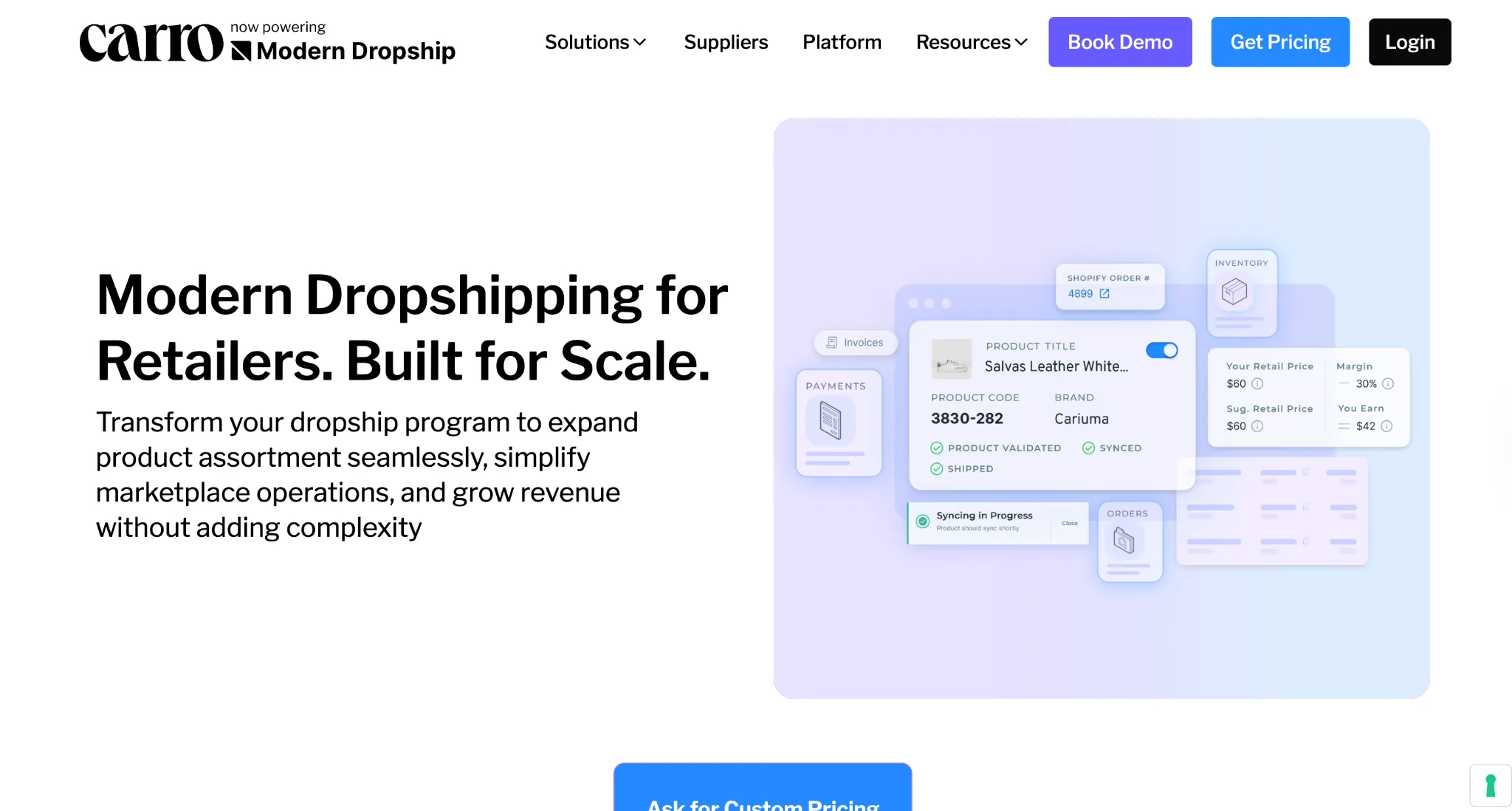
Carro is a dropship platform built for retailers and marketplace operators who want to grow their product catalog without the inventory risk, operational overhead, or capital commitment of traditional catalog expansion.
Rather than managing internal product data, Carro connects retailers to a network of 1,500,000+ products from vetted brand partners, automates the order routing and fulfillment workflow, and syncs product information in real time across major eCommerce platforms including Shopify, Magento, WooCommerce, and BigCommerce.
The core idea behind Carro is distributed retail: brands keep their inventory, retailers expand their assortment without holding stock, and orders are automatically routed to the correct fulfillment partner. The result is a unified customer experience on the retailer's storefront without the backend complexity of managing a traditional catalog.
While Akeneo solves the product data management problem for brands that own their catalog, we’re focused on solving the catalog expansion problem for retailers who want to grow their assortment without holding inventory. These are different problems, and Carro is built specifically for the second one.
Ideal For
- Retailers on Shopify, WooCommerce, BigCommerce, or Magento looking to expand their product selection without purchasing or warehousing inventory
- Marketplace operators building distributed supplier networks and needing end-to-end supplier onboarding, order routing, and fulfillment tracking from one platform
- Brands and suppliers wanting to distribute their products through trusted retailer partners without managing wholesale relationships or paid acquisition
- DTC brands with established audiences looking to add complementary products from other brands to increase average order value and repeat purchase rates
- Early-stage eCommerce businesses that want to test new categories with zero inventory risk before committing to purchasing
Top Features
- Hand-Matched Supplier Network: Our account managers actively match retailers with brand partners that align with their category, audience, and price point. This human curation differentiates Carro from generic dropship directories, where product quality and brand fit are inconsistent. Retailers get access to a curated network of 1,500,000+ products without having to source and qualify brands independently.
- Automated Order Routing and Fulfillment Tracking: When a customer places an order for a partner product, Carro automatically routes the order to the correct supplier and tracks fulfillment status. There's no manual forwarding, no email chains with suppliers, and no disconnected tracking. The customer sees one checkout and one order history; the retailer sees full visibility into partner fulfillment performance.
- Real-Time Sync Across eCommerce Platforms: Product information, pricing, and inventory levels are updated in real time across Shopify, Magento, WooCommerce, and BigCommerce. Carro also supports EDI and SFTP connections for partners with more complex integration requirements. When a supplier marks a product out of stock, that change propagates immediately across your storefront, protecting the customer experience without manual updates.
Why We're the Best Akeneo Alternative?
Carro doesn't replace Akeneo feature-for-feature because it solves a different problem. Akeneo helps companies manage and enrich product data for their own catalog. Carro helps retailers and marketplaces grow their catalog without owning the inventory.
For teams evaluating alternatives to Akeneo software because the platform is too expensive, too complex, or too focused on internal product data management, Carro represents a different path to catalog scale. Instead of spending months implementing a PIM and enriching data across thousands of internal SKUs, Carro activates supplier partnerships in weeks and routes orders automatically from day one.
For retailers whose core need is assortment expansion without inventory risk, Carro is one of the most direct solutions available – and for a broader look at how it compares to traditional inventory management software, see our full breakdown.
Pros
- No inventory risk: products are fulfilled by brand partners, removing balance sheet exposure and warehousing overhead
- Fast time to market: retailers can add new product categories in weeks without procurement, production, or logistics setup
- End-to-end automation from order routing to payouts, eliminating manual supplier management at scale
- Real-time sync across Shopify, Magento, WooCommerce, BigCommerce, EDI, and SFTP
Cons
- Not a traditional PIM: if your core need is enriching and managing structured product data for your own catalog, you need a dedicated PIM like Plytix, Salsify, or Pimcore alongside Carro
- Focused on the US market supplier network; international brand coverage may vary depending on the category and region
- Not suited for manufacturers who need master data management or localization across complex internal product hierarchies
Pricing
Carro offers a Standard Plan at 5% of sales, with integrations for Shopify, Magento, BigCommerce, and WooCommerce, plus end-to-end dropship automation. Note that Standard does not include a support plan.
The Growth Plan adds autonomous merchandising, priority support, a hand-matched supplier network, automated order routing, real-time sync, and seamless catalog expansion.
All plans include unlimited transactions, full platform access, automated payments, basic performance insights, and access to 1.5M+ products from top brands.
Final Verdict
Carro is the best overall Akeneo alternative for retailers, marketplace operators, and growing eCommerce brands whose goal is catalog expansion without inventory risk.
It's not a like-for-like PIM replacement, but for teams evaluating Akeneo because they need more product selection, better supplier workflows, or a faster path to assortment growth, Carro solves those problems more directly and at a fraction of the cost.
2. Salsify
Overview
Salsify is a cloud-native Product Experience Management (PXM) platform used by global brand manufacturers and retailers across consumer goods, food and beverage, electronics, and apparel.
It combines PIM and DAM capabilities with omnichannel syndication, retailer content validation, and digital shelf analytics. Brands including Mars, L'Oreal, Coca-Cola, Bosch, and ASICS use Salsify to manage product content and distribute it to retailer partners at scale.
Salsify is one of the best Akeneo alternatives in the market, owing to its syndication network and retailer-specific content rules, while Akeneo excels at internal product data enrichment. Salsify focuses on getting that content to retailer portals in the format each partner requires, with automated validation before submission.
Ideal For
- Large brand manufacturers and CPG companies that need to distribute product content to dozens of retail partners simultaneously
- Organizations with high SKU counts that need retailer-specific content validation before syndication
- Enterprise teams looking to centralize PIM and DAM in a single platform with a focus on digital shelf performance
- Brands already working with major retailers like Amazon, Walmart, Target, and Kroger who need direct channel connections
Top Features
- Retailer-Specific Content Rules and Automated Validation: Salsify maintains a network of retailer content requirements and validates product content against each before syndication. This prevents rejected listings and compliance failures at major retailers before submission.
- AI-Powered Workflow Automation: Salsify's Intelligence Suite embeds AI-powered task types into content workflows: translation, content generation, data extraction from digital assets, and quality auditing at scale. Teams can automate repetitive enrichment tasks rather than manually handling them for every SKU.
- Digital Shelf Analytics: Salsify's analytics tools give brand manufacturers visibility into how product content performs on retailer sites, including content quality scores, share of search, and competitive benchmarking. This closes the loop between content production and digital shelf performance.
Why Is It a Strong Akeneo Alternative?
Salsify is one of the best Akeneo alternatives for enterprise brand manufacturers who need PIM capabilities combined with direct retailer network connectivity. Its retailer syndication depth is more extensive than Akeneo's out-of-the-box offering, and its AI-powered workflows reduce manual content enrichment overhead at scale.
Pros
- Largest standardized retailer syndication network in the PIM category, with direct connections to major US and international retail channels
- AI-powered task automation embedded into content workflows
- Combines PIM and DAM in one platform, reducing tool fragmentation
- Strong digital shelf analytics for content performance measurement
Cons
- Pricing is significantly higher than most alternatives to Akeneo’s software platform: minimum contracts reported around $35,000/year, plus mandatory third-party onboarding partner fees of $16,000+ in some cases
- Complex onboarding; Salsify requires third-party consulting firms for implementation, which adds time and cost not covered in the base license
- UI criticized by users as slower and less intuitive than more modern platforms; multiple page loads required for basic product editing tasks
- Less suitable for SMBs or early-stage brands without dedicated implementation resources
Pricing
Salsify uses custom enterprise pricing with no published price list. Based on third-party data and verified user reports, minimum annual contracts start around $35,000/year, with additional mandatory third-party implementation partner costs that can add $16,000+ to first-year investment. Recommend that you connect with their sales team for a quote.
Final Verdict
Salsify is one of the best Akeneo alternatives for enterprise-grade brand manufacturers seeking robust retailer syndication, PIM and DAM combined alongside AI-powered workflows at scale.
It is not suitable for SMBs, teams without dedicated implementation resources, or retailers looking for catalog expansion rather than internal product data enrichment. The total first-year cost is among the highest in the category.
3. Plytix
Overview
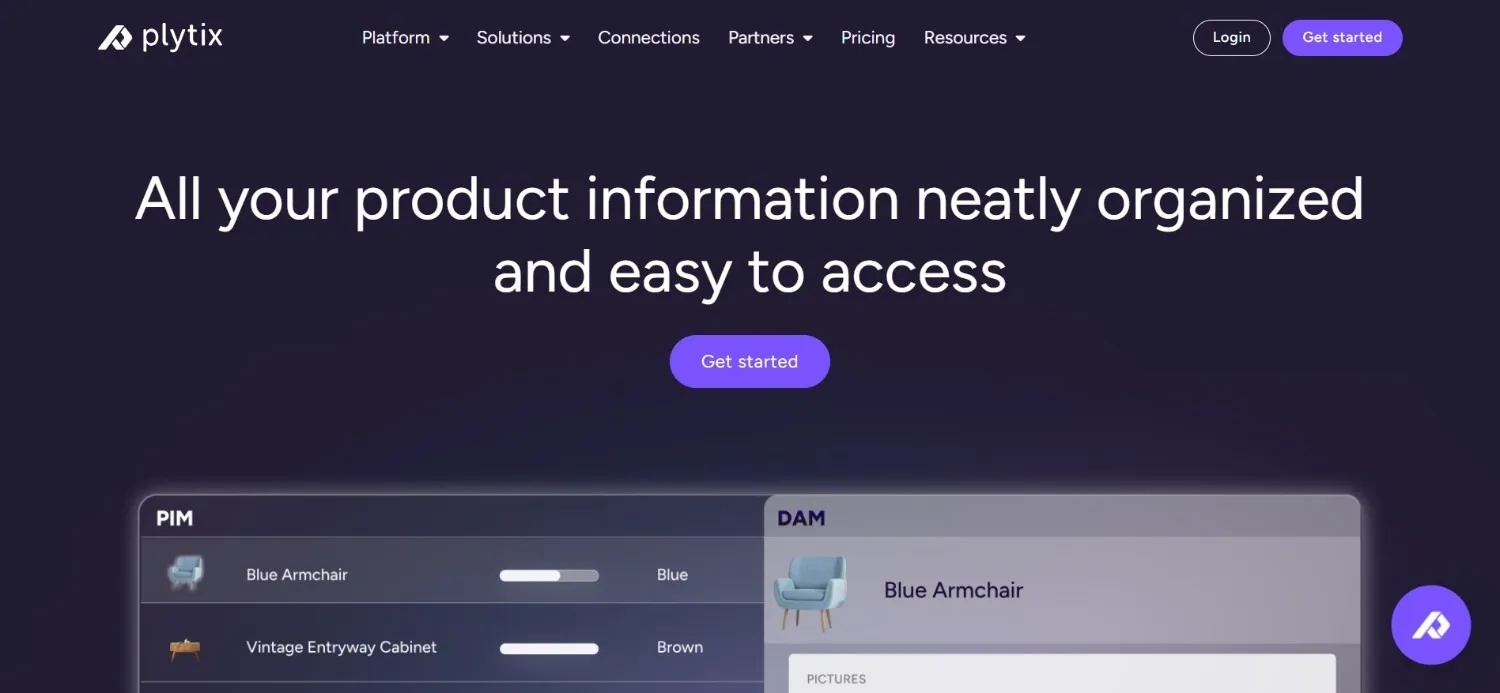
Plytix is a cloud-based PIM and DAM platform designed specifically for small and mid-sized businesses. Founded in 2016 and headquartered in Malaga, Spain, it has grown to serve 2,000+ brands across retail, consumer goods, and manufacturing.
G2 users have voted Plytix the easiest-to-use PIM tool in the market, and it consistently holds a 99% satisfaction score on the platform. Plytix includes unlimited users on every plan, removing the per-seat cost barrier that makes many enterprise PIMs inaccessible to growing teams.
Plytix is one of the most direct Akeneo alternatives for teams that find Akeneo either too expensive or too technically demanding. It covers PIM, DAM, brand portals, and built-in AI content generation in a single workspace, with an onboarding process measured in days rather than months.
Ideal For
- Small and mid-sized retailers, DTC brands, and wholesalers replacing spreadsheets with a structured PIM for the first time
- Teams that need a combined PIM and DAM without paying for two separate enterprise tools
- Growing brands that need unlimited user access without per-seat cost escalation slowing down team adoption
- Businesses selling across multiple channels (Shopify, BigCommerce, Amazon) that need a single source of truth for product data
Top Features
- Unlimited Users Across All Plans: Every Plytix plan includes unlimited users, meaning the entire team, including external collaborators and agency partners, can access the platform without additional seat costs. This directly addresses one of the most common frustrations with enterprise PIM pricing.
- Built-In AI for Content Generation and Optimization: Every Plytix plan includes 1,000 free AI credits per month for generating product descriptions, optimizing content, and editing images. Teams can automate routine content tasks without purchasing a separate AI tool or integration.
- Brand Portals and Automated Product Data Sheets: Plytix's brand portals give retail partners and buyers 24/7 access to the latest product information in a structured, shareable format. Automated product data sheets generate and update product documentation across the entire catalog without manual reformatting.
Why It's a Strong Akeneo Alternative?
Plytix is one of the best alternatives to Akeneo software for SMBs and mid-market teams. It matches Akeneo's core PIM capabilities at a fraction of the cost, removes the per-seat barrier entirely, and offers faster onboarding through in-house data import rather than implementation partner dependencies.
Pros
- Most affordable full-featured PIM in the category with a free plan available
- Unlimited users on all plans, including free tier
- In-house onboarding with product data import included, no external implementation partner required
- Built-in AI credits for content generation on every plan
Cons
- Less suitable for large enterprises with highly complex product hierarchies, custom taxonomies, or advanced localization needs at scale
- Integration depth is narrower than enterprise PIMs like Akeneo or Salsify; REST API available but fewer native connectors
- Some features available only as paid add-ons, which can increase monthly cost beyond the base plan price
Pricing
Plytix uses a usage-based pricing model built around SKU count, AI credits, and optional add-ons. A free Standard plan is available for up to 1,000 SKUs with no outputs.
The Pro plan starts at approximately €499/month ($549/month in the US) and includes up to 50,000 SKUs, unlimited users, and advanced team management features.
The Enterprise plan offers custom pricing for unlimited SKUs, custom API calls, and multi-account management. All plans are billed monthly with no long-term commitment required.
Final Verdict
Plytix is one of the best Akeneo alternatives for SMBs and mid-market teams that need a capable, affordable PIM without the enterprise price tag or implementation complexity.
It's not the right fit for large enterprises with complex compliance requirements, advanced data governance needs, or global localization at scale.
4. Pimcore

Overview
Pimcore is an open-core platform that consolidates PIM, DAM, MDM, CDP, DXP, and eCommerce into a single unified solution. Founded in 2013 and headquartered in Salzburg, Austria, it serves 118,000+ customers across Fortune 100 companies including Pepsi, Sony, and Audi. Gartner and Forrester both recognize Pimcore across multiple data and experience management categories.
Unlike Akeneo, which is primarily a PIM with add-on modules, Pimcore provides a fully unified platform where product data, digital assets, customer data, and digital experiences are managed from a single codebase.
It can be deployed on-premise, in the cloud, or as a fully managed PaaS, giving organizations full control over their infrastructure and data governance.
Ideal For
- Mid-to-large enterprises that need a single platform for PIM, DAM, MDM, and DXP without building multiple integrations between separate tools
- Organizations in regulated industries that require full data governance and on-premise deployment options
- Enterprises with complex, custom product data models that need a highly configurable PIM with no restrictions on product count, attributes, or hierarchies
- Technical teams with developer resources who can configure and extend the platform to their specific workflows
Top Features
- Unified PIM, DAM, MDM, and DXP from a Single Codebase: Pimcore's platform consolidates product data, digital assets, master data, and digital experience management without requiring separate tools or integrations. Product count, attributes, hierarchies, users, and assets all operate without usage-based restrictions, making it one of the most cost-predictable options at scale.
- Pimcore Copilot and Workflow Automation: Pimcore Copilot brings AI-assisted content generation and workflow automation directly into the platform, helping teams generate, enrich, and validate product content without manual bottlenecks. Workflow automation handles approval chains, content routing, and data quality checks.
- Full Infrastructure Flexibility: Pimcore supports on-premise, cloud, and fully managed PaaS deployments. For enterprises with data sovereignty requirements or IP-sensitive product data, the on-premise option is a meaningful differentiator. No usage-based, consumption-based, or GMV-based pricing applies, regardless of deployment model.
Why It's a Strong Akeneo Alternative?
Pimcore is one of the best Akeneo alternatives, especially for enterprises that want a unified data platform rather than a standalone PIM. Its open-core architecture eliminates the per-product and per-user pricing that makes other enterprise PIMs expensive at scale, and its deployment flexibility addresses data sovereignty and compliance requirements that cloud-only platforms can't.
Pros
- Open-core architecture with no limits on users, products, assets, or sites
- Unified platform covering PIM, DAM, MDM, DXP, and eCommerce without separate tool integrations
- Full infrastructure flexibility: on-premise, cloud, or managed PaaS deployment
- Recognized by Gartner and Forrester across data and experience management categories
Cons
- Requires significant technical expertise to implement and configure; most deployments need a certified Pimcore partner
- Total cost rises significantly when partner implementation and ongoing maintenance are included
- The community (free) edition is suitable for smaller projects but lacks enterprise support and advanced features
- Steeper learning curve than more opinionated, out-of-the-box PIM tools
Pricing
Pimcore offers a free Community Edition, with commercial plans starting at $9,900/year for Professional, $29,900/year for Enterprise, and $39,900/year for PaaS. The paid editions include features like LTS, 24/7 support, and in the PaaS plan, all-inclusive hosting and operations.
Final Verdict
Pimcore is one of the good Akeneo alternatives in the market; especially useful for enterprises seeking unified, highly configurable data and experience platforms with no per-usage pricing and full infrastructure control.
It's not suitable for teams without developer resources, organizations looking for fast deployment without a technical partner, or SMBs needing a turnkey PIM solution.
5. InRiver
Overview
inRiver PIM is a cloud-based Product Information Management platform designed for mid-to-large manufacturers, distributors, and retailers with complex, structured product catalogs.
Founded in 2007 and headquartered in Malmö, Sweden, inRiver serves global enterprise accounts across industrial, consumer goods, and B2B distribution sectors. The platform is built around a dynamic data model that supports complex product structures without requiring custom development for every new use case.
iInRiver differentiates from Akeneo with its focus on product lifecycle management, go-to-market workflow orchestration, and deep support for industrial and B2B product data structures. It's recognized in Gartner evaluations as one of the leading platforms for manufacturers with complex product catalogs that span multiple data sources, regional specifications, and channel-specific requirements.
Ideal For
- Mid-to-large manufacturers and distributors with complex, hierarchical product structures across multiple product families, variants, and specifications
- B2B companies that need product information enriched and distributed across distributor portals, dealer networks, and retailer channels simultaneously
- Organizations needing a PIM that covers the full product lifecycle from product introduction through end-of-life
- Global enterprises with strong localization and multi-language requirements at the product attribute level
Top Features
- Dynamic Data Modeling: inRiver's data model is schema-agnostic, allowing product managers to configure attributes, relationships, and hierarchies without developer involvement. This makes it one of the more adaptable PIMs for manufacturers with unusual or complex product structures that don't fit standard PIM templates.
- Content Planning and Go-to-Market Workflows: inRiver includes content planning features that track progress across product launch workflows, assigning tasks and routing approvals between teams. This gives product teams and channel managers visibility into content readiness before syndication, reducing launch delays.
- Multichannel Publishing and Syndication: inRiver distributes product content to eCommerce platforms, marketplaces, distributor portals, and print channels from a single source. Its channel-specific content configuration lets teams define what attributes appear in each output without maintaining separate product records per channel.
Why It's a Strong Akeneo Alternative?
inRiver is one of the strongest Akeneo alternatives for mid-to-large manufacturers and industrial distributors who need deeper data modeling flexibility and product lifecycle workflow support than Akeneo's standard configuration provides. Its dynamic data model and go-to-market workflow features address gaps that Akeneo's community frequently raises around complex B2B product structures.
Pros
- Dynamic, schema-agnostic data model supports complex product structures without developer involvement
- Strong product lifecycle management and go-to-market workflow orchestration
- Well-suited for industrial manufacturing and B2B distribution use cases
- Recognized by Gartner for its handling of complex product data structures
Cons
- Premium pricing with no published tiers; enterprise contracts are typically in the same range as Akeneo's enterprise edition
- Longer implementation timelines than out-of-the-box SaaS PIM tools; typically requires partner-led setup
- Less accessible for SMBs or teams without PIM implementation experience
- Narrower integration ecosystem than Salsify for direct retailer syndication
Pricing
Inriver’s pricing is customized and quote-based, with no public fixed price on the plans page. It groups customers into Foundation, Core, Professional, and Enterprise tiers, all tailored to business size and needs, so you need to contact sales for exact range.
Final Verdict
inRiver is recommended for mid-to-large manufacturers and B2B distributors with complex product hierarchies that need a flexible data model and product lifecycle management capabilities. It's not suitable for SMBs, teams without PIM implementation resources, or organizations primarily focused on retail syndication rather than product data governance.
6. SalesLayer

Overview
Sales Layer is a cloud-based PIM platform focused on fast deployment and practical usability for teams that need to centralize product data and distribute it across channels without months of setup. Founded in 2013 and based in Valencia, Spain, it serves 400+ clients across retail, manufacturing, and distribution.
Sales Layer is particularly noted for its speed of deployment compared to heavier enterprise PIMs, and for its supplier portal feature that lets brands onboard external partners directly into the product content workflow.For teams seeking the best Akeneo alternatives because its implementation timeline is too long or its pricing is too high, Sales Layer offers a faster path to a functioning PIM without a full implementation partner engagement.
Ideal For
- Mid-market retailers and manufacturers that need a PIM deployed in weeks rather than months
- Teams managing product content across multiple eCommerce platforms, marketplaces, and distributor portals
- Organizations with a supplier or vendor network that needs to submit and update product data directly into the PIM
- Growing brands transitioning from spreadsheets to structured product information management for the first time
Top Features
- Automated Data Synchronization Across Channels: Sales Layer syncs product data automatically across connected channels, reducing the manual export-import cycle that teams using spreadsheets or basic catalog tools typically rely on. When a product attribute updates, that change propagates to all connected outputs.
- Customizable Catalog Portals: Sales Layer's catalog portal feature lets teams create branded, shareable product catalogs that give buyers, distributors, and retail partners access to up-to-date product information without sending static PDF files. Portals update automatically as product data changes.
- Supplier and Collaborator Portal: Sales Layer includes a portal for external partners to submit, update, and validate product data directly, reducing the manual re-entry that product teams typically handle when onboarding new suppliers or vendors.
Why It's a Strong Akeneo Alternative?
Sales Layer is one of the more practical alternatives to Akeneo software for mid-market teams that need a fast, capable PIM without enterprise implementation complexity. Its speed-to-value is consistently cited by users as a differentiator from heavier platforms like Akeneo, and its supplier portal addresses the external contributor workflow that Akeneo requires custom development to replicate.
Pros
- Fast deployment: many teams report going live in weeks rather than months
- Supplier and collaborator portal included out of the box
- Strong multi-platform integration coverage: Amazon, Google Shopping, eCommerce platforms, and more
- Transparent, practical UI with lower learning curve than enterprise PIMs
Cons
- Less depth for very large enterprises with complex data governance requirements or advanced localization at scale
- Pricing is custom-tailored based on the customer’s requirements, which might be exponentially higher than your allotted budget
- Fewer AI-powered features than newer platforms like Salsify or Plytix
- Some users report that advanced data modeling requires support engagement rather than self-service configuration
Pricing
Sales Layer uses a flexible, quote-based pricing model with plans like Scale, Premium, Enterprise, and Enterprise Plus, and pricing depends on users, SKUs, and features. It also offers a free 30-day trial, with annual or monthly billing options available.
Final Verdict
Sales Layer is one of the best Akeneo alternatives for mid-market teams that need a practical, fast-deploying PIM with built-in supplier collaboration and multi-channel distribution. It's less suitable for large enterprises with complex data governance or compliance requirements, and for teams that need deep AI-powered enrichment features.
7. Syndigo

Overview
Syndigo is a cloud-native PXM platform built specifically for consumer goods brands and retailers in grocery, hardlines, electronics, apparel, and healthcare.
It integrates PIM, MDM, DAM, syndication, and real-time analytics in a composable architecture, with particular strength in compliance-heavy verticals like food, beverage, and pharmaceutical goods where data accuracy and regulatory compliance are non-negotiable.
Syndigo's core differentiator is the Syndigo Marketplace, the largest standardized product content database in the category, which provides verified vendor product information for brand manufacturers and retailers operating in regulated industries. It also operates as a GDSN-certified data pool, making it a natural fit for brands that need to exchange standardized product data across global trading partner networks.
Ideal For
- CPG brands and retailers operating in compliance-heavy verticals: grocery, foodservice, healthcare, pharmaceutical, and hardlines
- Organizations that need GDSN-certified data pool connectivity for global product data exchange
- Large retail buyers and distributors that need standardized, verified supplier product data fed directly into their procurement systems
- Enterprises with high-volume vendor management requirements where data accuracy and compliance are business-critical
Top Features
- GDSN-Certified Data Pool and Syndigo Marketplace: Syndigo operates as a certified Global Data Synchronization Network (GDSN) data pool, enabling brands and retailers to exchange standardized, verified product data with trading partners across the global supply chain. The Syndigo Marketplace provides access to the largest standardized product content database in the category.
- Real-Time Content Distribution and Compliance: Syndigo distributes product content in real time across its retailer network, with automated content validation against retailer-specific data requirements. This prevents listing rejections and compliance failures at major retail partners before submission.
- Configurable Integrations and Low-Code Setup: Syndigo uses low-code/no-code configuration and industry-specific accelerator templates to speed up deployment. A complete software development kit and existing vendor data libraries also reduce implementation time compared to greenfield PIM deployments.
Why It's a Strong Akeneo Alternative?
Syndigo is one of the stronger Akeneo alternatives for CPG brands and retailers operating in regulated, compliance-heavy verticals where GDSN connectivity and standardized data exchange are required.
Its combination of PIM, MDM, DAM, and syndication in a single platform removes the need for multiple connected tools that most enterprise PIM deployments require.
Pros
- GDSN-certified data pool connectivity for global standardized product data exchange
- Largest standardized product content database in the category
- Strong compliance and data validation for regulated consumer goods verticals
- Combines PIM, MDM, DAM, and syndication in a single composable platform
Cons
- Pricing is custom and typically positioned at the enterprise tier, making it inaccessible for smaller brands and retailers
- Less flexible for general catalog management outside CPG, grocery, and regulated retail verticals
- No published pricing; requires full engagement with Syndigo's sales team before cost assessment is possible
- Implementation complexity comparable to other enterprise PIMs
Pricing
Syndigo uses custom enterprise plans with no published tiers. All in all, the pricing range varies by organization size, vertical, channel connections, and module selection. That being said, they currently charge on a “per item generated” basis - with the lowest pricing tier being $165/item, and going up to $255/item.
Final Verdict
Syndigo is recommended for large CPG brands, food and beverage manufacturers, and retailers in compliance-heavy verticals that need GDSN-certified data exchange and standardized product content distribution at scale. It's not suitable for general-purpose catalog management, SMBs, or teams outside the core Syndigo verticals.
8. 1Worldsync
Overview
1WorldSync is a cloud-based product content network and GDSN-certified data pool provider, focused on helping brands and retailers exchange standardized, accurate product data across global trading partner networks.
It serves 30,000+ brands across retail, CPG, healthcare, and food service, providing infrastructure for product content collection, data quality validation, and syndication across the 1WorldSync network and third-party channels.Unlike Akeneo, which is a general-purpose PIM, 1WorldSync is purpose-built for organizations that need to comply with global data standards and exchange product information with trading partners through standardized registries.
Ideal For
- Global brands that need GDSN-certified data pool connectivity for standardized product data exchange with international trading partners
- CPG, healthcare, and food service companies operating in markets where GS1 data standards are required for retail compliance
- Retailers that source products from hundreds of suppliers and need a standardized mechanism for receiving and validating product data at scale
- Organizations that are already 1WorldSync customers and need to expand their data exchange coverage
Top Features
- GDSN-Certified Registry and Data Pool: 1WorldSync is one of a small number of certified GDSN data pool providers globally, enabling brands and retailers to exchange standardized GS1-compliant product data with any trading partner network worldwide. For organizations operating in international retail or with global supply chains, GDSN connectivity is often a non-negotiable compliance requirement.
- Standardized Product Content Collection: 1WorldSync manages the collection of product information from suppliers using standardized templates and validation workflows, reducing the data quality issues that arise when supplier-submitted content arrives in inconsistent formats.
- Network Reach Across Retail and Distribution: 1WorldSync connects brands directly to major retail and distribution networks, enabling content distribution without separate bilateral integrations for each trading partner.
Why It's a Strong Akeneo Alternative?
1WorldSync is one of the more specific Akeneo alternatives for organizations whose primary need is GDSN-certified, standards-compliant product data exchange across global trading partner networks. For this use case, it provides infrastructure that Akeneo doesn't natively replicate.
Pros
- GDSN-certified data pool with global trading partner network coverage
- Strong in regulated verticals: food, beverage, healthcare, hardlines
- Standardized collection and validation reduces supplier data quality issues
- Direct connections to major global retail and distribution networks
Cons
- Narrow use case: strong for global data exchange, but limited as a general-purpose PIM for internal catalog management
- Less flexibility for custom data models or non-standardized product content workflows
- Pricing is available on request and typically requires enterprise-level commitment, which might be unaffordable or too expensive for smaller organizations
- Not suitable for teams needing rich content authoring, DAM, or eCommerce content enrichment
Pricing
1WorldSync offers flexible, custom pricing across plans for emerging, mid-market, enterprise brands, and retailers/distributors, so exact costs depend on business needs.
Final Verdict
1WorldSync is one of the best Akeneo alternatives, especially for large global brands and retailers in regulated industries that need GDSN-certified data pool connectivity and standardized product data exchange at scale. It's not suitable as a primary PIM for catalog management, content enrichment, or eCommerce-focused product information workflows.
9. Pimberly
Overview
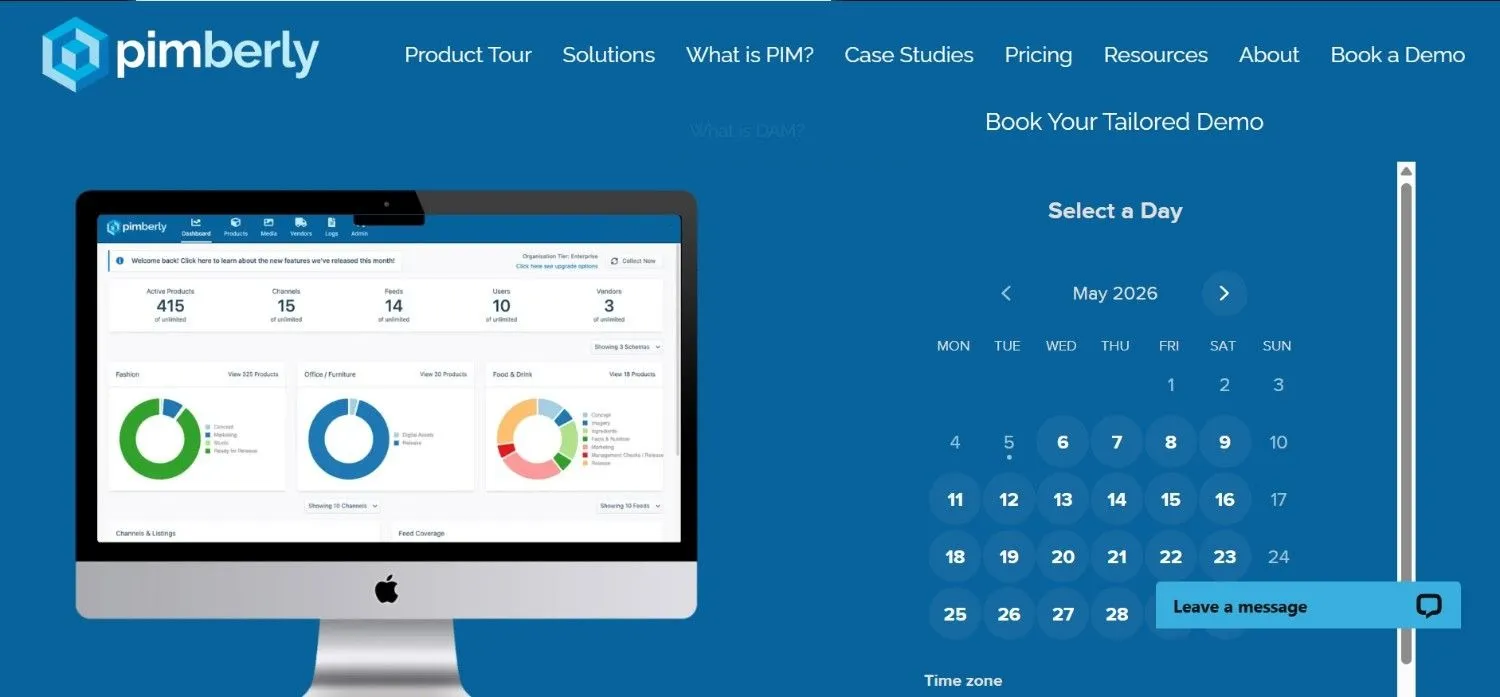
Pimberly is a cloud-based SaaS PIM and DAM platform designed for mid-market and growing enterprise brands focused on data quality, global localization, and fast time-to-market across multiple channels. It blends PIM capabilities with Digital Information Management (DIM) features, helping brands manage complex localization requirements, regulatory content, and channel-specific data formatting without extensive custom development.
Pimberly is positioned specifically for product-led organizations that need to manage high-quality, localized product content across global markets and multiple eCommerce channels simultaneously, while maintaining the speed to market that enterprise PIMs often sacrifice in favor of configuration depth.
Ideal For
- Mid-market and mid-enterprise brands with strong global operations that need localization and regulatory content management at scale
- Retailers and manufacturers managing product content across multiple language markets and regional compliance requirements
- Brands expanding internationally that need a PIM capable of handling market-specific attributes, regulatory documentation, and localized product descriptions
- Organizations looking for a PIM that balances automation and data quality with faster deployment than traditional enterprise PIMs
Top Features
- Automation-Driven Data Enrichment: Pimberly's automation engine handles routine product data tasks: generating attribute values, triggering approvals, and pushing data to downstream channels based on configurable rules. Teams spend less time on manual data entry and more time on exception handling and enrichment.
- Global Localization and Multi-Market Support: Pimberly supports localization at the attribute level, enabling brands to maintain market-specific product data, translations, and regulatory content within a single platform. This is one of Pimberly's clearest differentiators for organizations managing global product catalogs.
- Data Quality Scoring and Completeness Tracking: Pimberly tracks data quality scores across the catalog, surfacing completeness gaps and attribute errors before content goes live. Teams can set channel-specific quality thresholds and monitor progress across product launches.
Why It's a Strong Akeneo Alternative?
Pimberly is one of the best Akeneo alternatives for mid-market and growing enterprise brands that need a capable, automation-driven PIM with strong global localization support. Its automation depth and data quality features address specific gaps that Akeneo's Community Edition leaves for teams that need more structured workflow support without a full enterprise implementation.
Pros
- Strong automation engine for reducing manual data enrichment tasks
- Global localization and multi-market attribute management at the product level
- Data quality scoring and completeness tracking across the catalog
- Designed for mid-market deployment speed with enterprise feature depth
Cons
- Pricing starts at €36,000/year ($39,000/year in US dollars), placing it above SMB budgets
- No free plan or trial; evaluation requires a sales engagement
- Less suitable for teams outside the retail and consumer goods verticals where Pimberly's features are most relevant
- Integration ecosystem smaller than established enterprise PIM platforms
Pricing
Pimberly uses subscription pricing starting at approximately €36,000/year ($39,000/year in US dollars) for mid-market deployments, and the highest pricing goes up to €90,000 ($98,000/year in US dollars). Contact Pimberly’s sales team for a quote based on catalog size, user requirements, and channel scope.
Final Verdict
Pimberly is recommended for mid-market brands with global operations that need a capable, automation-driven PIM with strong localization and data quality features. It's less suitable for SMBs, teams outside retail and consumer goods, or organizations looking for a lower-cost entry point into structured product data management.
10. Stibo Systems
Overview
Stibo Systems is an enterprise Master Data Management (MDM) platform with strong PIM capabilities, serving large global organizations across retail, manufacturing, distribution, and financial services.
Founded in 1794 as a printing company and transitioned to data management software in the 1990s, Stibo Systems brings decades of enterprise data governance experience to its product. It serves major global enterprises that need to manage product data alongside customer, supplier, and location data in a single governed MDM framework.
Unlike Akeneo and most PIM tools on this list, Stibo Systems approaches product data management as a subset of broader enterprise master data governance, making it the strongest fit for organizations where product information is one of several critical data domains that need to be managed, related, and governed together.
Ideal For
- Large global enterprises that need a unified MDM platform covering product, customer, supplier, and location data in a single system
- Retail and manufacturing organizations with significant data governance and compliance requirements across multiple data domains
- Enterprise IT and data governance teams building long-term master data management infrastructure
- Organizations in highly regulated industries where data lineage, audit trails, and governance documentation are non-negotiable
Top Features
- Multi-Domain MDM Architecture: Stibo Systems manages product data alongside customer, supplier, location, and financial data domains, enabling enterprises to create relationships across data types that most PIM tools handle in isolation. This is a meaningful capability for global enterprises where product data needs to connect to supplier networks, customer records, and regional compliance frameworks.
- Comprehensive Data Governance and Workflow: Stibo Systems provides configurable approval workflows, audit trails, access controls, and data stewardship tools designed for enterprise compliance requirements. For organizations that need full data lineage and governance documentation across the master data lifecycle, Stibo's governance framework is one of the most mature in the market.
- Scalability for Complex Enterprise Requirements: Stibo Systems is built for large-scale deployments with millions of product records, complex data models, and global distribution requirements. Its architecture is designed for enterprises that have outgrown traditional PIM tools and need platform-level scalability.
Why It's a Strong Akeneo Alternative?
Stibo Systems is one of the strongest Akeneo alternatives for large global enterprises that need MDM-level data governance across multiple data domains, not just a standalone PIM. For organizations where product data management is embedded within broader master data governance requirements, Stibo Systems provides infrastructure that Akeneo doesn't cover.
Pros
- Multi-domain MDM covering product, customer, supplier, and location data in a single governed platform
- Mature data governance and audit trail capabilities for enterprise compliance requirements
- Built for large-scale deployments with millions of records and complex global data structures
- Decades of enterprise data management experience across major global verticals
Cons
- Significantly higher implementation complexity and total cost than any PIM-only alternative on this list
- Not suitable for SMBs, mid-market teams, or organizations without dedicated MDM and data governance resources
- Pricing is license-based and available on request; enterprise contracts are typically in the six-figure annual range
- Long deployment timelines typical of enterprise MDM projects: months to over a year for full production deployment
Pricing
Stibo Systems uses a license-based enterprise pricing model. No public pricing is available. Enterprise contracts are typically six figures annually, and you’ll need to contact Stibo Systems’ sales team independently.
Final Verdict
Stibo Systems is recommended for large global enterprises that need multi-domain MDM with comprehensive data governance across product, customer, and supplier data simultaneously. It's not suitable for organizations that need a fast-deploying PIM, teams without dedicated data governance infrastructure, or any organization that doesn't require MDM-level complexity.
Why Carro Works Across Multiple Use Cases?
- Carro for Retailers Expanding Their Catalog
Retailers that have hit an assortment ceiling often look at PIM tools like Akeneo to organize a larger catalog. But in many cases, the catalog doesn't need better organization – it needs more products. We address that gap directly by connecting retailers to 1,500,000+ products from vetted brand partners without requiring procurement, inventory investment, or warehouse changes.
Retailers using Carro have seen up to 3x catalog size increases and up to 180% average order value growth. VYSN built a scalable brand network on Carro, expanding their product assortment across multiple platforms from a single centralized place; without adding operational friction.
- Carro for Online Marketplace Operators
Pure-play marketplace operators need a platform that manages supplier onboarding, order routing, fulfillment tracking, and payouts across dozens or hundreds of brand partners. Carro's marketplace infrastructure automates all of these workflows from a single control layer.
Where Akeneo helps brands manage internal product data, we help marketplaces with managing the full supplier relationship lifecycle, from partner onboarding to real-time inventory sync to automated settlement.
- Carro for Brands and Suppliers Expanding Distribution
Brands that want to expand into new retail channels often face a choice between traditional wholesale negotiations, building their own DTC channel, or investing in paid acquisition.
Our platform provides them a fourth option: connecting brands with curated retailer partners whose customers already match the brand's target audience. Brands on Carro can approve each retail partner, define pricing and margin structures, and receive immediate payouts when products sell across partner storefronts. This removes the cash flow delays and complex terms that wholesale relationships typically involve.
- Carro for DTC Brands Increasing Average Order Value
DTC brands with established audiences often need complementary products to round out their offering and increase basket size, but don't want the inventory risk and procurement overhead of buying in new categories.
platform connects DTC brands with complementary partner products that can be listed and sold through the existing storefront without purchasing any inventory.
- Carro for New Marketplace Launches
Teams launching a new marketplace don't need to build custom dropship infrastructure before going to market. Carro's modular architecture provides order routing, inventory sync, supplier onboarding, and settlement out of the box, with integrations to Shopify, Magento, WooCommerce, and BigCommerce ready from day one.
For early-stage marketplace businesses, this removes the need to engineer marketplace infrastructure from scratch, allowing teams to focus on supplier partnerships, merchandising, and customer acquisition rather than backend operations.
What Makes a Good Akeneo Alternative?
It Solves Your Actual Problem
Akeneo is a PIM. If you're looking at Akeneo alternatives because you need better product data management for an internal catalog, you need another PIM.
If you're looking for alternatives because Akeneo doesn't support your catalog expansion, dropship, or marketplace model, you need a different category of tool entirely. The right alternative solves the problem you actually have.
Pricing Matches Your Stage and Model
Akeneo's enterprise pricing starts around $40,000/year. That's appropriate for organizations with the team, catalog complexity, and technical resources to extract value from it. For everyone else, the right alternative needs pricing that reflects the actual scope of use. Plytix offers a free plan.
Carro charges 5% of sales. Sales Layer offers a 30-day trial with subscription pricing. Evaluate alternatives on total first-year cost, including implementation, not just license fees.
Deployment Speed Matches Your Timeline
Akeneo enterprise implementations typically take months. If you need a functioning product data or catalog management system in weeks, shortlist alternatives with faster deployment models: Plytix imports your product data for you; Carro activates supplier partnerships in weeks; Sales Layer consistently delivers faster go-lives than enterprise PIM deployments.
Integration Depth Covers Your Stack
Your PIM or catalog management tool needs to connect to the systems you're already running: your eCommerce platform, ERP, DAM, order management system, and retailer portals.
Evaluate whether each alternative has pre-built connectors for your specific stack or whether you'd be building custom integrations.
Support Model Matches Your Internal Resources
Some alternatives to Akeneo software require implementation partners, dedicated data teams, and ongoing developer resources to maintain. Others include onboarding support, in-house data import, and ongoing customer success at no extra cost.
If you don't have a dedicated PIM administrator or developer team, the support model should be part of your evaluation criteria.
How to Choose the Right Akeneo Alternative for Your Needs?
Choosing the best Akeneo alternative for your use case can be an uphill task. Here’s how you can simplify the process:
- Define Whether You Need a PIM or a Catalog Expansion Tool
This is the most important question in the evaluation. PIMs manage product data you already own. Catalog expansion tools like Carro grow your assortment through external partner networks without inventory.
If you're evaluating Akeneo alternatives because Akeneo doesn't support your growth model, make sure the alternative you choose is actually solving the problem Akeneo wasn't designed for.
- Match Team Size and Technical Resources to the Platform
Pimcore and Stibo Systems require developer resources and partner-led implementations. Plytix and Sales Layer are designed for teams without dedicated PIM administrators.
Carro requires no technical setup beyond connecting your eCommerce platform. Be honest about your team's capacity for implementation and ongoing maintenance.
- Evaluate Total First-Year Cost, Not Just License Price
The gap between the advertised license fee and the actual first-year cost is significant in the PIM category. Salsify users report mandatory third-party implementation costs of $16,000+ on top of the license.
Pimcore enterprise deployments include partner fees that can exceed the license cost. Build the complete cost picture before comparing alternatives side by side.
- Check Retailer and Channel Integration Coverage
If distributing product content to specific retail partners, marketplaces, or wholesale channels is part of your workflow, verify that the alternative has the channel connections you need. Syndigo and Salsify have the deepest retailer network coverage.
Our platform, Carro, has the deepest dropship supplier network. inRiver has strong B2B distributor connectivity. The right coverage depends on your distribution model.
- Run a Real Proof of Concept Before Committing
Most alternatives to Akeneo’s software platform offer a free plan, free trial, or proof-of-concept period. Plytix offers a free plan with no time limit.
On the contrary, we offer a straightforward onboarding process. Sales Layer provides a 30-day trial. Pimcore offers a free Community Edition for initial evaluation. Use these options to validate the platform against your actual catalog, data, and workflow before committing to an annual contract.
Everything You Need to Know About Akeneo Alternatives
| Category | Key Considerations |
|---|---|
| Top 3 Alternatives | Carro (inventory-free catalog expansion), Plytix (affordable PIM for SMBs), Salsify (enterprise PXM with retailer syndication) |
| Best Overall Option | Carro for retailers and marketplace operators; Plytix for SMBs needing a traditional PIM; Salsify for enterprise brand manufacturers |
| Why Look for Akeneo Alternatives? | Enterprise pricing (~$40,000+/year), complex implementation requiring partners, limited support for marketplace and dropship models, open-source Community Edition requires developer resources |
| How to Choose? | Define your actual problem (internal product data vs. catalog expansion); match platform to team size and technical resources; evaluate total first-year cost including implementation |
| Price Range | Free (Plytix free plan, Pimcore Community) to ~$39,000+/year (Pimberly, billed in EUR) to $40,000+/year (Salsify, Akeneo Enterprise) |
| Ease of Switching | Plytix and Carro offer the fastest onboarding; Salsify and inRiver require partner-led implementations; Pimcore requires developer resources |
| Must-Have Features | Depends on use case: for PIM, look for flexible data modeling, localization, and syndication; for catalog expansion, look for supplier network, automated order routing, and real-time sync |
Ready to Move On from Akeneo? Try Carro
If you're evaluating Akeneo alternatives because the platform is too expensive, too complex to implement, or simply not designed for how your business grows, Carro offers a different path.
We connect retailers and marketplace operators to 1,500,000+ products from vetted brand partners, automating order routing from sale to fulfillment, and syncing product data in real time across Shopify, Magento, WooCommerce, and BigCommerce. There's no inventory risk, no per-seat licensing, and no implementation partner required.
Carro is built for US-based retailers and marketplace operators, with native integrations for Shopify, WooCommerce, BigCommerce, and Magento, and no custom development required to get started.
There are several options you can explore when searching for the best inventory management software, but if you’re looking to grow your assortment without inventory risk or operational overhead, Carro is an ideal solution.
Frequently asked questions
What is Akeneo used for?
Akeneo is a Product Information Management (PIM) platform used to centralize, enrich, and distribute structured product data across multiple sales and marketing channels. It helps brands and retailers manage product attributes, variants, digital assets, and localized content from a single governed repository. Akeneo is most commonly used by mid-to-large enterprises with complex product catalogs that need to publish consistent data across eCommerce platforms, marketplaces, and print catalogs.
Which is the best Akeneo alternative in 2026?
If your goal is growing your catalog without holding inventory and expanding assortment through supplier partnerships rather than managing internal product data, Carro is the most direct solution. We connect retailers and marketplace operators to 1.5 million+ products from vetted brand partners, with automated order routing and real-time sync across Shopify, WooCommerce, BigCommerce, and Magento.
What features should I look for in an Akeneo alternative?
When evaluating alternatives to Akeneo software, prioritize: flexible data modeling that matches your product structure; integration coverage for your eCommerce platforms, ERP, and retailer portals; deployment speed and the support model required to go live; pricing transparency including implementation costs, not just license fees; and whether the platform supports the specific workflow you need, whether that's internal product data management or catalog expansion through partner networks. If your goal is to grow a catalog without inventory, look for automated order routing, real-time supplier sync, and supplier onboarding infrastructure rather than PIM data modeling features.
How do I choose the best Akeneo alternative for my needs?
To choose the best Akeneo alternative for your needs, start by defining your actual problem. If you need to enrich and distribute internal product data, choose a PIM: Plytix for SMBs, Sales Layer for mid-market speed, or Salsify for enterprise retailer syndication. If you need to expand your product catalog without holding inventory, Carro is the most direct solution. Then evaluate total first-year cost including implementation, match the platform's technical requirements to your team's resources, and run a proof of concept using a free plan or trial before committing to an annual contract.
Is it easy to switch from Akeneo to an alternative?
Switching from Akeneo to an alternative varies significantly by platform. Talking about our platform, Carro doesn't require data migration at all since we connect you to a new supplier network rather than managing your existing catalog. On the other hand, Salsify and inRiver involve structured implementation processes similar to Akeneo's, typically taking weeks to months. Pimcore requires developer resources for migration. The key variable is whether the alternative can import your existing product catalog in a structured way or whether you're starting fresh.
Can I use Carro alongside an existing PIM like Akeneo?
Yes, Carro and Akeneo solve different problems so they can coexist in the same tech stack. Akeneo manages and enriches your internal product data. Carro expands your catalog through external supplier partnerships and automates the order routing and fulfillment workflow for those partner products. Retailers that already have a PIM for their owned catalog can use Carro to add a dropship layer for partner products without migrating their existing data or replacing their PIM infrastructure. Carro integrates directly with Shopify, Magento, WooCommerce, and BigCommerce, so products from partner brands appear in your storefront alongside your owned catalog.