

Best Inventory Management Software for Magento (Adobe Commerce) in 2026: Feature & Pricing Comparison
.png)
April 9, 2026

Key Takeaways (TL;DR)
Managing inventory on Magento (Adobe Commerce) requires robust software that can handle complex catalogs, multi-warehouse locations, and high transaction volumes.
Without the right tools, you risk stockouts, overselling, and operational chaos.
- Carro is the Best Choice for Catalog Expansion: If your goal is to grow your SKU count without buying inventory, Carro is the definitive solution for establishing dropship partnerships on Magento.
- ERP vs. IMS: Understanding whether you need a standalone Inventory Management System (IMS) or a full-scale Enterprise Resource Planning (ERP) suite is critical for budget and implementation success.
- Automation Wins: The best inventory management software for Magento automates order routing, stock syncing, and reordering, saving you countless hours of manual work.
- Scalability is Non-Negotiable: Magento is an enterprise-grade platform. Your inventory tool must be able to handle thousands of SKUs and orders without slowing down your site speed.
- Integration Depth: Look for native integrations or robust APIs that ensure real-time data flow between your Magento store, warehouse, and accounting software.
Table of Contents
- Top Inventory Management Software for Magento in 2026: At a Glance
- Why Magento Requires Specialized Inventory Management
- How to Choose the Best Inventory Management Tools for Magento
- Top Inventory Management Software for Magento in 2026
- How Carro Transforms Magento Inventory Management
- Everything You Need to Know About Magento Inventory Management
- Frequently Asked Questions (FAQs)
Top Inventory Management Software for Magento in 2026: At a Glance
Why Magento Requires Specialized Inventory Management
Running a store on Magento (now Adobe Commerce) is a whole different ball game compared to simpler platforms. It is a beast designed for scale, customization, and power.
Because of this, using a basic plugin or a simple spreadsheet to manage stock simply won't cut it. According to Harvard Business Review, stockouts alone are estimated to cost retailers close to 1 trillion dollars per year globally, which means even small inventory mistakes can quickly turn into serious revenue loss and damaged customer trust.
The best inventory management software for Magento needs to respect the platform's architecture.
Magento stores often handle complex product types - configurable products, bundled items, and grouped products. A generic tool might treat a "Red T-Shirt, Size L" as a single line item, but Magento sees it as a child product of a configurable parent. If your software can't map these relationships correctly, your inventory data will be a mess.
Furthermore, 2026 has seen a rise in "Composable Commerce." Retailers are breaking apart their monolithic stacks and choosing best-in-breed tools for specific jobs.
Your inventory management software for Magento must act as the central source of truth, feeding accurate stock levels to your frontend, your marketplaces (like Amazon or eBay), and your physical POS systems in real-time.
How to Choose the Best Inventory Management Tools for Magento
Before diving into our top picks, let's set the stage. What transforms an inventory tool from merely "functional" into a genuine growth engine for a Magento store?
Here’s what to look for when choosing an inventory management solution for Magento:
1. Native Integration & Real-Time Sync
A seamless connection is essential.
Does the software integrate directly with Magento via a dedicated extension or robust API?
The best inventory solutions offer a native, bi-directional sync, ensuring that data flows instantly between your systems without relying on clunky middleware. This eliminates a potential point of failure and ensures your stock levels are always accurate, everywhere.
2. Multi-Source Inventory (MSI) & Distributed Logistics Support
Since Magento 2.3, Multi-Source Inventory (MSI) has been a core feature, allowing merchants to fulfill a single order from multiple warehouses, storefronts, or even dropship partners.
Your inventory software must not only support this logic but enhance it.
Can it intelligently route orders based on stock availability, shipping costs, and customer location? Can it manage inventory from both your own stock and third-party suppliers in one unified view?
This capability is crucial for creating an efficient, modern fulfillment network.
3. Scalability, Performance, and Reliability
High-volume is the name of the game for many Magento merchants.
Can your inventory system handle a catalog of 50,000+ SKUs? What happens when you get hit with 10,000 orders an hour during a Black Friday flash sale?
The software must process immense volumes of data in real-time without introducing lag or slowing down your site's performance. It needs to be the reliable backbone of your operation, not a bottleneck.
4. Advanced Automation and Workflow Intelligence
In today's competitive landscape, manual adjustments are a recipe for failure. The best platforms automate critical workflows.
Look for features like:
- Automated Order Routing Orders for partner products are automatically sent to suppliers for fulfillment, eliminating manual processes and reducing errors.
- Low-stock alerts that prevent stockouts.
- Automated purchase order generation to replenish inventory efficiently.
- Supplier management tools that streamline communication and performance tracking.
If you're still manually updating spreadsheets in 2026, you're falling behind.
5. Cost vs. Value: A Clear Return on Investment
Inventory software pricing can range from affordable monthly subscriptions to enterprise suites costing over $50,000 annually. The sticker price isn't the whole story. You need to evaluate each tool based on its total cost of ownership, pricing transparency, and the tangible ROI it delivers. Does the software save you enough time, prevent lost sales, and unlock new growth opportunities to justify its cost?
The best solutions pay for themselves many times over, and Carro is no exception with its flexible pricing that scales with your business. The Build Plan is $149/month with a 7% fee per sale, the Scale Plan is $299/month with a lower 5% fee and dedicated support, and the Enterprise Plan offers custom pricing, the lowest rates, and full API access.
A great platform doesn't just manage inventory; it unlocks revenue streams that make its cost a no-brainer.
Top Inventory Management Software for Magento in 2026
We have analyzed the market to bring you the definitive list of the top contenders.
Whether you're a marketplace operator looking to expand your assortment, an e-commerce director aiming to boost GMV, a growth leader seeking to scale product selection, or a DTC brand searching for new sales channels, one of these tools is your perfect match.
1. Carro
Overview:
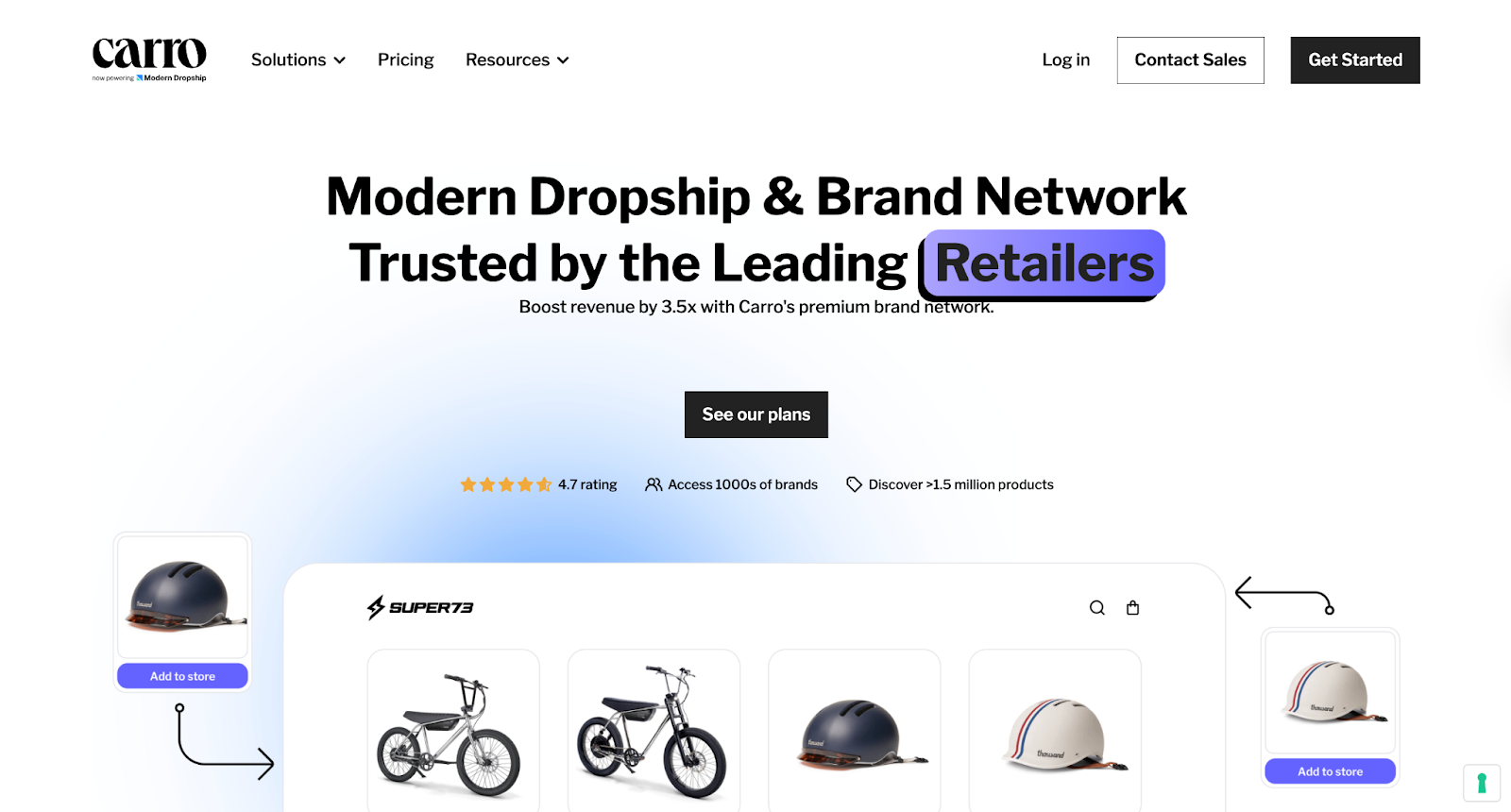
Carro is a powerful platform that helps e-commerce retailers and marketplaces expand their product catalogs and drive growth without holding inventory. By connecting with trusted brand partners, Carro lets you test new categories and boost revenue without the risks of traditional stock management.
Its automation streamlines everything - from supplier onboarding and product syncing to order routing and payouts - ensuring a seamless experience. For Magento users, Carro transforms inventory limitations into opportunities, allowing you to fill assortment gaps through its collaborative commerce model.
Purpose-built for modern e-commerce, Carro enables scalable, inventory-free growth by managing logistics so you can focus on growing your business and enhancing the customer experience.
By integrating with Magento, Carro unlocks "virtual inventory," letting you partner with top brands to sell their products. When a customer buys, the order is routed to the partner for fulfillment.
You get the sale, they ship the product, and the customer enjoys a seamless experience.
Key Features:
- Virtual Inventory at Your Fingertips: Instantly expand your product catalog by selling goods from other top-tier brands - without ever holding the stock yourself. Real-time inventory sync prevents overselling and keeps your virtual shelves stocked.
- Automated Order Routing: Imagine a customer buys one of your products and one from a partner. Carro’s smart system automatically splits the order, sending it to the right place for fulfillment. You get the sale, they ship the product, and your customer gets a seamless experience.
- Curated Brand Discovery Network: This isn't just any supplier list. Gain access to Carro's exclusive network of thousands of premium, vetted brands that are ready to partner and help you grow.
- Unified Checkout Experience: Customers can buy a mix of your products and partner products in a single, frictionless transaction, increasing your Average Order Value (AOV) without any extra effort.
Pros:
- Expand Your Catalog, Not Your Warehouse: Instantly add complementary products from trusted brands without any capital investment in stock. Forget warehousing and fulfillment costs for partner products - Carro handles it all.
- Boost Your Average Order Value: By offering a wider, more compelling product selection, you naturally encourage customers to add more to their carts, driving up revenue with every transaction.
- Eliminate Inventory Risk: Test new product categories and market trends with confidence. Since you don't hold the inventory, there's no risk of unsold stock or balance sheet liabilities.
- Partner with Premium Brands: Move beyond generic dropship suppliers. Carro connects you with high-quality, vetted brand partners that align with your brand and delight your customers.
Who is it for?
Magento retailers seeking to scale quickly without inventory risks can leverage curated marketplaces and lifestyle brand solutions tailored to their needs. Whether you're a legacy retailer modernizing your dropship program, an online marketplace expanding operations, or a DTC brand exploring new distribution channels, these strategies address key pain points like supplier management, operational complexity, and assortment expansion.
Pricing:
Carro operates on a usage-based model with subscription tiers, ensuring costs align directly with your revenue growth.
Carro offers flexible pricing tiers to match your growth. The Build Plan starts at $149/month with a 7% fee per sale, unlimited partnerships, and customizable order delays. For those looking to expand, the Scale Plan is $299/month, reducing the fee to 5% and adding white-glove onboarding, a dedicated merchandising manager, and customer data sharing. Finally, the Enterprise Plan provides custom pricing with the lowest available rates, comprehensive API access, and advanced support for larger businesses. All plans offer a 20% discount with annual payment.
All plans come with unlimited transactions, access to Carro's automated dropshipping platform, automated payments and billing, basic performance insights, access to over 1,500,000 products from top brands, and best-in-class priority support.
Final Verdict:
Carro is unique on this list because it solves the problem of inventory (cost and risk) rather than just managing it. If growth via catalog expansion is your goal, Carro is the clear winner.
2. Brightpearl
Overview:
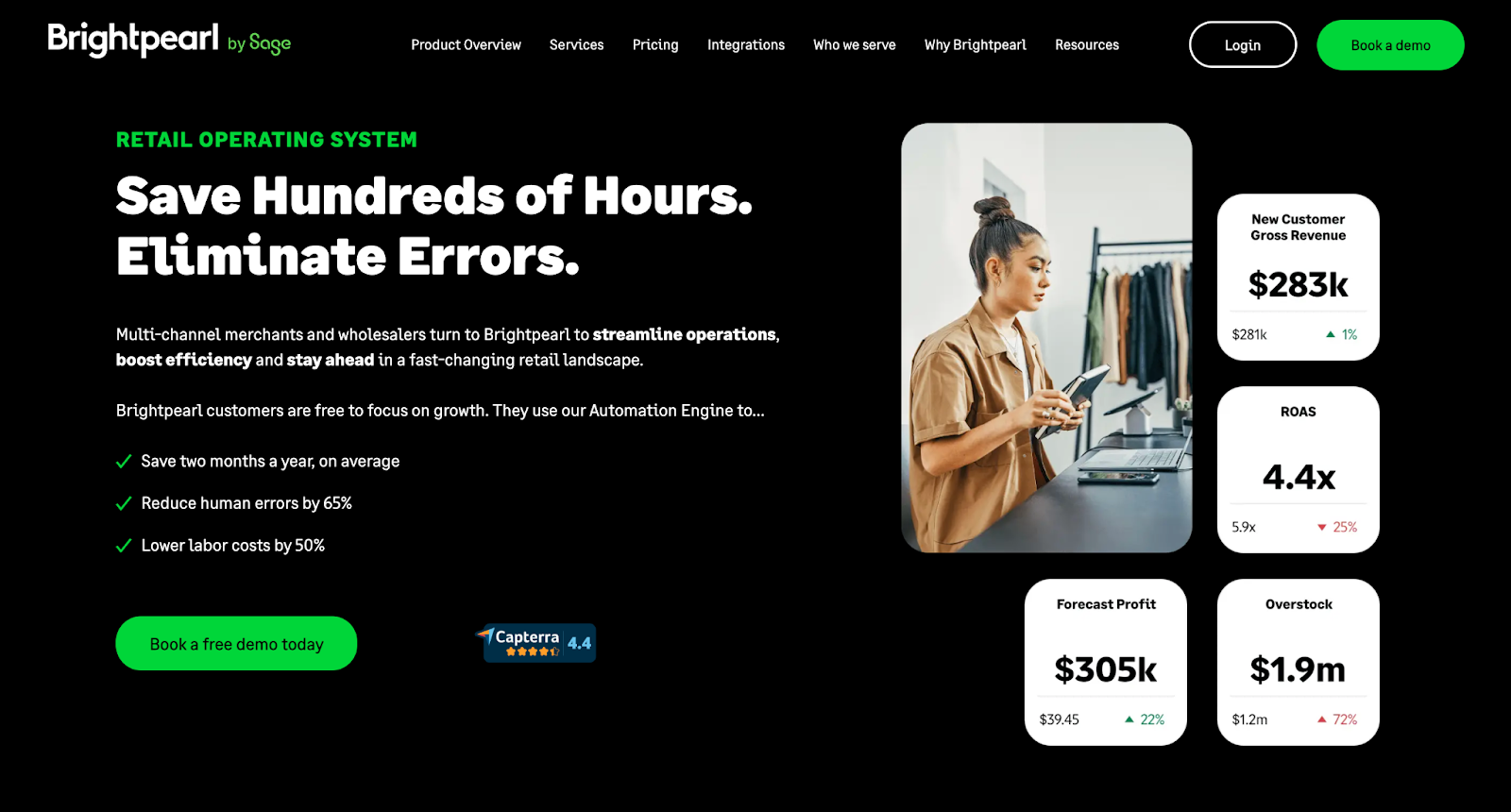
Brightpearl positions itself not just as inventory software, but as a Retail Operating System (ROS) designed specifically for retail and wholesale.
Owned by Sage, Brightpearl is built for hyper-scalability. It handles inventory, accounting, order management, and CRM in one platform. Its "Automation Logic" is particularly powerful for Magento merchants who need to route orders based on complex rules (e.g., "If order value > $500 and location is NY, ship from Warehouse B via FedEx Overnight").
Key Features:
- Automation Engine: Set rules for shipping, fulfillment, and customer communication.
- Real-Time Accounting: Built-in accounting software that updates financials with every sale and stock movement.
- Demand Planning: Data-driven insights to forecast what you need to buy and when.
- High-Volume Connector: Their Magento connector is built to handle massive order spikes.
Pros:
- Handles the financial side of inventory (COGS, landed costs) exceptionally well.
- Extremely stable and reliable for high-volume merchants.
- Excellent customer support and implementation teams.
Who is it for?
Mid-to-large retailers doing $1M to $50M in GMV who need a robust backend that covers both operations and finance.
Pricing:
Brightpearl uses custom quote-based pricing. It is generally on the higher end, reflecting its enterprise-grade capabilities.
Final Verdict:
Brightpearl is a reliable solution for Magento if you need your inventory software to handle accounting and complex automation rules, but it’s not the simplest tool to use.
3. Linnworks
Overview:
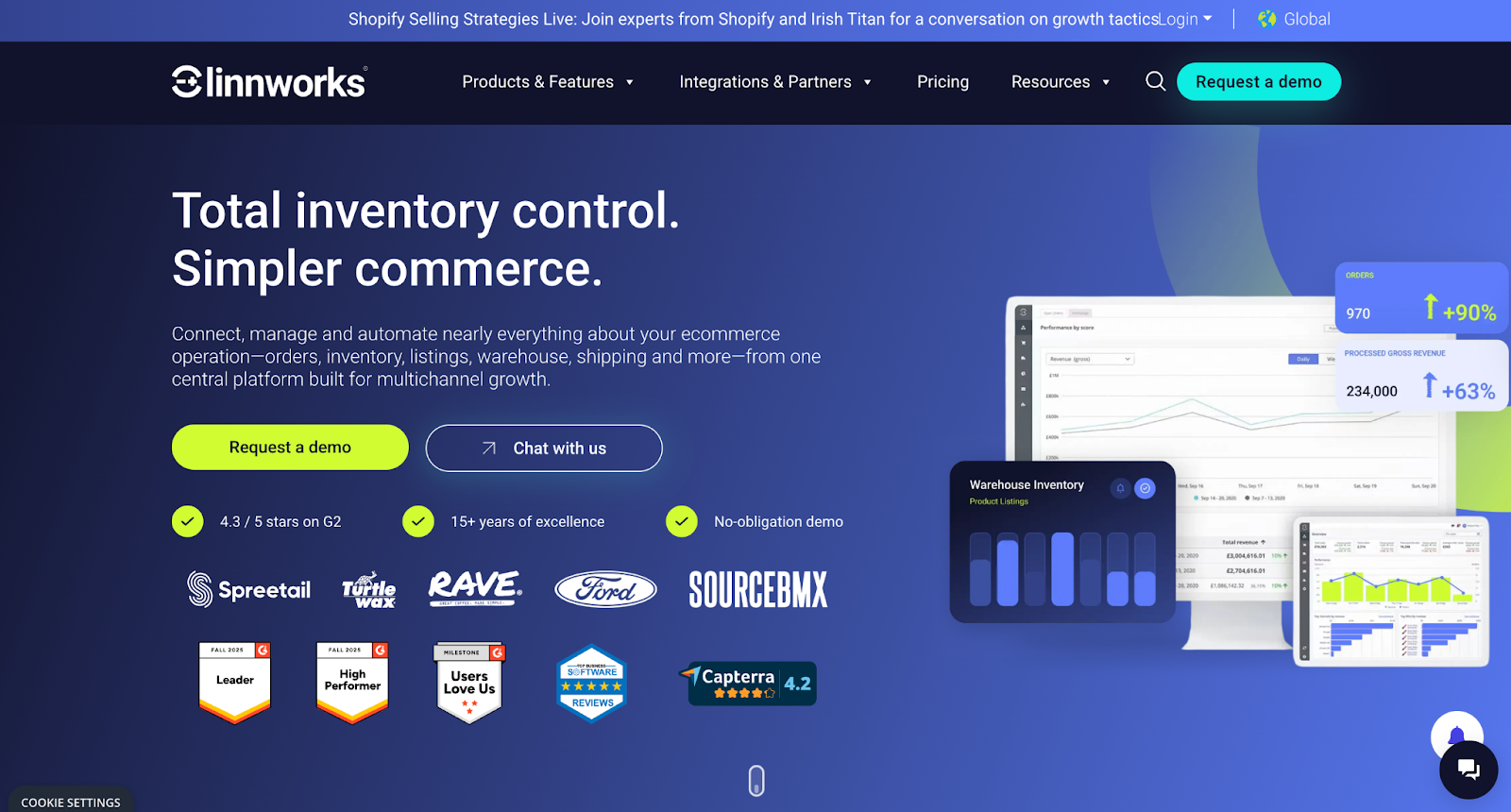
Linnworks is a powerhouse for sellers who are everywhere - Magento, Amazon, eBay, Walmart, and beyond.
Linnworks is designed to centralize your operations. It acts as the command center, pulling orders from every channel and pushing accurate stock levels back out. Its strength lies in its vast ecosystem of integrations, allowing you to connect Magento to virtually any shipping courier or marketplace globally.
Key Features:
- Multi-Channel Sync: Updates inventory across dozens of channels in near real-time.
- Shipping Management: Compare shipping rates and print labels directly from the platform.
- Stock Forecasting: Analyzes sales history to predict future stock needs.
- Customizable Reporting: Deep dive into profitability by SKU, channel, or location.
Pros:
- One of the best interfaces for managing multi-channel listings.
- Huge library of integrations.
- Highly customizable workflows.
Who is it for?
Retailers who use Magento as their brand hub but generate significant revenue on third-party marketplaces like Amazon and eBay.
Pricing:
Quote-based, typically starting with a monthly subscription fee plus costs for additional users or high order volumes.
Final Verdict:
If your strategy is to "be everywhere" Linnworks is a great inventory management software choice. It masterfully simplifies the chaos of omni-channel selling, but its complexity and quote-based pricing can be a significant hurdle for smaller brands.
4. Veeqo
Overview:
Veeqo (now owned by Amazon) disrupted the market by making its software completely free.
While optimized for Amazon, Veeqo has a solid Magento integration. It provides inventory control, picking and packing scanners, and shipping software.
The catch? Amazon wants you to buy shipping labels through them (where they make their money), but the software itself has zero monthly fees.
Key Features:
- Barcode Scanning: Mobile app for picking and packing in the warehouse.
- Shipping Integration: Deep integration with Amazon Buy Shipping and major carriers.
- Inventory Rules: Basic automation for stock syncing.
Pros:
- Veeqo offers a free plan with no monthly fees.
- Great if you fulfill significantly through Amazon FBA or want Amazon-like shipping rates.
- Simple, modern interface.
Who is it for?
Smaller Magento merchants or those with a heavy Amazon presence who want a capable tool without the monthly SaaS bill.
Pricing:
Veeqo offers a free "Shipping" plan with unlimited orders, users, and integrations. They generate revenue through shipping carrier rates. Paid plans, starting from $19/month, unlock advanced features like inventory management, demand forecasting, and digital picking. High-volume plans are also available for enterprise needs.
Final Verdict:
Veeqo covers the essentials perfectly and offers incredible value for budget-conscious merchants, but it lacks the depth of Carro or NetSuite.
5. NetSuite

Overview:
NetSuite is a well-known name in the ERP world.
We're talking about a complete business management suite. For global brands running Magento, NetSuite offers unparalleled depth in supply chain visibility, financial compliance, and international multi-subsidiary management.
Key Features:
- Global ERP: Manage multiple currencies, tax laws, and subsidiaries.
- Advanced Warehouse Management (WMS): sophisticated bin tracking, wave picking, and cycle counting.
- Supply Chain Tower: End-to-end visibility from raw materials to final delivery.
Pros:
- Infinitely scalable.
- Highly customizable (with the help of developers).
- The "final destination" for growing businesses - you won't outgrow it.
Who is it for?
Enterprise-level Magento merchants (usually $50M+ revenue) with complex, global operations.
Pricing:
High. NetSuite pricing varies based on edition, user count, modules, and implementation complexity. Licensing typically ranges from $25,000 to over $250,000 annually, with one-time implementation fees between $10,000 and $100,000+.
Final Verdict:
NetSuite can be costly and may only be worth it if your business complexity truly justifies the investment.
6. Cin7

Overview:
Cin7 (Core and Omni) focuses heavily on "Connected Inventory."
Cin7 bridges the gap between a basic IMS and a full ERP. It is particularly strong for businesses that have a mix of B2B (wholesale), B2C (Magento), and B2B2C (marketplaces) channels. It includes a built-in Point of Sale (POS) system, making it great for brands with physical stores.
Key Features:
- Built-in POS: Syncs physical store sales with your Magento inventory instantly.
- B2B Portal: Allows wholesale customers to place orders online.
- Production Module: Light manufacturing features (Bill of Materials) for brands that make their own goods.
Pros:
- Excellent for brands that do both manufacturing and retail.
- Strong POS integration for brick-and-mortar synchronization.
- Comprehensive B2B features.
Who is it for?
Mid-market brands that manufacture their own products or have physical retail locations alongside their Magento store.
Pricing:
Monthly subscription model, accessible for mid-sized businesses with flexible pricing options. The Standard package ($349/month) is ideal for small businesses starting with inventory management, while the Core Pro package ($599/month) suits growing businesses with more users, integrations, and features like material requirements planning. High-volume businesses can opt for the Core Advanced plan ($999/month) with advanced warehouse management, or enterprises with complex needs can choose the fully customizable Omni plan (pricing on request).
Final Verdict:
Cin7 is a versatile all-rounder. It handles the "make, move, and sell" lifecycle of a product better than most competitors in its price range, but it can be overwhelming for smaller businesses with simpler needs.
7. Magestore

Overview:
Magestore takes a different approach by building its software inside Magento.
Unlike SaaS tools that connect via API, Magestore is a native extension. This means it lives in your Magento dashboard. It uses the PWA (Progressive Web App) technology to deliver a fast, app-like experience for POS and inventory management directly within your existing infrastructure.
Key Features:
- Native Integration: No API connection errors or sync delays. It is Magento.
- PWA POS: Modern point-of-sale system that works on any device.
- Barcode Management: Generate and print barcodes directly from Magento admin.
Pros:
- Real-time data because there is no external database to sync.
- One-time payment model (ownership) vs. recurring SaaS fees.
- Highly customizable code since it's open source (like Magento).
Who is it for?
Merchants who want to keep everything "under one roof" and have a developer team capable of managing a heavy Magento installation.
Pricing:
One-time license fee plus annual support costs.
Final Verdict:
For Magento purists who want total control and data sovereignty, Magestore is the logical choice.
8. QuickBooks Commerce (formerly TradeGecko)

Overview:
Although QuickBooks Commerce has refocused its priorities, many legacy users and certain regions continue to rely on its core functionality, formerly known as TradeGecko.
Ideally suited for small to medium businesses, this tool shines in its simplicity and effectiveness for wholesale and manufacturing workflows. It tracks raw materials and finished goods seamlessly.
Key Features:
- B2B Ecommerce Platform: Set up a separate store for wholesale buyers.
- Manufacturing Order Management: Track production stages.
- Mobile App: Manage sales and stock on the go.
Pros:
- Very user-friendly interface.
- Great integration with QuickBooks Online for accounting.
- Strong B2B capabilities.
Who is it for?
Small manufacturers or wholesale-focused brands running Magento who need accounting integration.
Pricing:
Monthly subscription tiers are based on order volume. Plans range from the "Simple Start" at €21/month to the "Advanced" tier at €75/month, with significant introductory discounts available.
Final Verdict:
A solid, user-friendly choice for smaller operations that need to manage light manufacturing and wholesale alongside retail, but it lacks scalability for growing businesses.
How Carro Transforms Magento Inventory Management
Traditional inventory management is about control. Carro is about growth.
Picture visiting a new store you’ve heard great things about. The brand looks promising, and you’re curious to check it out. But when you walk in, the shelves are empty. This is a common challenge for retailers with limited capital - they can only afford so much inventory.
Retailers and marketplaces need a broader product selection to stay competitive, but traditional expansion is challenging. It requires tying up capital, adding overhead, hiring staff, and managing complex supplier relationships. Coordinating orders and maintaining a consistent customer experience across fulfillment networks adds to the headache.
Carro simplifies this process with inventory-free growth and end-to-end automation to tackle these challenges.
Instead of just tracking the inventory you own, Carro allows you to expand your product catalog by selling goods from other top-tier brands - without ever holding the stock yourself.
These are some of the benefits:
- Seamless Integration: Carro plugs into your Magento architecture, treating partner products just like your own.
- No Risk: You don't pay for the product until you make a sale. Cash flow constraints disappear.
- Automated Ops: When an order comes in for a partner item, Carro’s system splits the order and notifies the supplier. You don't lift a finger.
Still have questions?
Worried about quality control? Unlike traditional dropshipping with generic suppliers, Carro focuses on curated partnerships with trusted brands you handpick. Concerned about a complicated setup? Carro integrates seamlessly with Shopify and Magento, letting you launch in weeks, not months. For brands, maintaining control is crucial - Carro lets you approve every retail partner and set your pricing to ensure your standards are upheld.
Even if you're early-stage, Carro is built to scale with you. Start small, test the waters, and grow your partnerships as your revenue grows. It's a low-risk, high-reward solution for ambitious brands.
By using Carro alongside your core inventory management software for Magento, you create a hybrid model: maximize margins on your owned inventory while maximizing reach and LTV (Lifetime Value) with virtual inventory.
Ready to stop counting stock and start scaling sales? Get started with Carro today.
Everything You Need to Know About Magento Inventory Management
Frequently Asked Questions (FAQs)
How to manage inventory in Magento?
Managing inventory in Magento can be streamlined by leveraging third-party tools like Carro. Instead of manually tracking stock, Carro’s platform allows you to integrate virtual inventory seamlessly into your Magento setup, creating a powerful hybrid model. With automated syncing and real-time updates, you can expand your product offerings through a network of trusted suppliers while eliminating manual processes.
What is the best overall inventory management software for Magento?
For Magento users, Carro stands out as the best overall inventory management software. Unlike repurposed tools, Carro is purpose-built for marketplace and dropshipping models. It provides a dependable infrastructure that scales with your product assortment and revenue, handling the complexities of an extended catalog without adding risk or overhead. More than just software, Carro is a strategic partner designed to drive business growth and ensure your operations are built for long-term success.
Does Magento have built-in inventory management?
Yes, Magento (Adobe Commerce) comes with a feature called Multi-Source Inventory (MSI). This allows you to manage stock across multiple physical locations and assign products to specific sources. However, it lacks advanced features like demand forecasting, automated purchase orders, and complex warehouse workflows found in dedicated software like Carro.
What is the difference between ERP and Inventory Management Software?
Inventory Management Software (IMS) focuses on tracking stock levels, orders, and fulfillment. Enterprise Resource Planning (ERP) software includes IMS but also manages other business functions like accounting, HR, Customer Relationship Management (CRM), and manufacturing. ERPs are typically more expensive and complex, designed for larger enterprises.
How does Carro help with inventory management on Magento?
Carro helps by eliminating the need to manage physical inventory for new product lines. It allows you to dropship products from partner brands. The inventory levels are synced automatically from the partner's store to your Magento store, ensuring you never sell an out-of-stock item, all without you having to count, store, or ship the goods yourself.
Will Carro be too complex or time-consuming to implement?
Not at all. Carro is designed for a fast and easy setup, so you can go to market in weeks, not months. Our platform was built to get you selling faster. With pre-built integrations for major platforms like Magento, Shopify and BigCommerce, plus support for EDI/SFTP, you can connect your store and start expanding your product catalog without the need for complex, custom development.


Related Posts
.png)
.png)
.png)
