Best Rokt Catalog Alternatives in 2026 (Top Tools Compared)
Payout delays? Limited network? Compare 9 Rokt Catalog alternatives, including Carro, Salsify & Feedonomics, rated by features, fit & price. Find your fit.

Key Takeaways (TL;DR)
- Rokt Catalog Is Narrow by Design: Rokt Catalog (formerly Canal) is a distributed commerce tool for brands that want to sell through a curated network of retail partners without managing logistics or integrations. It works within the Rokt ecommerce ecosystem and is best suited to brands looking for passive retail distribution.
- Inventory-Free Growth Needs More Than a Network: The biggest gap with Rokt Catalog is operational depth. It connects brands to retailers, but does not give retailers the infrastructure to run a supplier network, automate order flows, or actively curate and expand their catalog at scale.
- Best for End-to-End Supplier Orchestration: Carro is purpose-built for US-based retailers and marketplace operators who need more than catalog placement, it provides a hand-matched brand network of 1.5M + products, automated order routing, real-time sync, and reliable payout settlement from a single platform. It's the only option on this list that actively finds new supplier partners for you and automates the entire operational layer behind each transaction.
- What Sets Carro Apart: We are the only platform here that actively matches retailers with brand partners through human curation, rather than requiring teams to source or discover suppliers on their own.
- How to Choose: Start by identifying whether you are primarily a brand (looking for retail distribution) or a retailer (looking to expand your assortment). Then verify storefront compatibility and whether the platform handles order routing, payouts, and supplier management or just catalog discovery.
Top Rokt Catalog Alternatives in 2026 at a Glance
| Tool | Best For | Key Features | Pros | Cons | Pricing |
|---|---|---|---|---|---|
| Carro | Retailers and marketplaces expanding assortment without inventory | Hand-matched supplier network, real-time sync, automated order routing, EDI & API support | Curated supplier network, revenue-share pricing, proven retailer results | Best for dropship/marketplace models; not a passive brand distribution tool | 5% of sales (Standard) |
| Feedyio | Shopify merchants distributing product feeds to marketplaces and comparison sites | XML/CSV/TXT feed generation, 100+ predefined templates, Shopify Markets support | 5-star rated, easy to use, free plan available | Feed export tool only; no dropship or supplier network | From $9.99/month; highest price range being $29.99/month |
| Akeneo | Mid-market to enterprise brands managing and enriching product information | AI-powered enrichment, omnichannel distribution, open-source Community Edition | Free tier available, large ecosystem, strong for complex catalogs | Setup complexity; paid tiers are enterprise-priced | Starts at $45,000/year on the lower-end; upper limit based on customer's requirement |
| Rithum | Enterprise brands managing dropship and marketplace across 420+ channels | AI-powered (RithumIQ), private marketplace support, $50B GMV network | Massive channel network, unified brand/retailer view, strong analytics | Significant post-merger price increases; rigid; slow support | Custom pricing; GMV-based fee structure |
| Feedonomics | Mid-market to enterprise brands managing product feeds across 300+ channels | Full-service feed management, AI-enriched data, 300+ channel exports, 24/7 support | Industry-leading feed specialists, strong data governance, proven at scale | No public pricing; steeper learning curve; custom quote only | Custom pricing; based on SKU count and other factors |
| Mirakl | Enterprise retailers launching third-party seller marketplaces | Seller onboarding, AI catalog scoring, 450+ connectors | Enterprise-grade marketplace infrastructure, strong AI tooling | Enterprise pricing; significant implementation complexity | Custom pricing; scales based on growth in GMV |
| ShipStation | SMBs needing multi-carrier fulfillment management | 400+ carrier integrations, branded tracking, multi-channel order sync | Affordable entry pricing, user-friendly, broad carrier support | Shipping/fulfillment focus only; not a dropship or catalog tool | From $9.99/month; plans scale based on shipment volume and other factors |
| Logicbroker | Enterprise retailers managing dropship programs through EDI and API | EDI/API/XML/CSV support, AI-powered exception management, $10B+ GMV processed | Handles the most complex enterprise trading partner ecosystems | Enterprise-only pricing; not publicly disclosed; complex onboarding | Custom pricing; connect with sales team for tailored rates |
| Sellvia | Beginners and solopreneurs launching US-based dropship stores | US-based fulfillment, curated product catalog, ready-made store option | Affordable entry price, fast US shipping (1-3 days), 14-day free trial | US shipping only; limited customization; mixed user reviews on billing transparency | From $39/month onwards |
| Salsify | Enterprise brands focused on digital shelf management across retail channels | PIM + DAM + syndication unified, digital shelf analytics, retailer network | One of the most complete enterprise PXM platforms available | Starts at ~$35,000+/year; mandatory implementation partner | Custom pricing; connect with their sales team for tailored prices |
Why Consider Rokt Catalog Alternatives?
What Rokt Catalog Does Well?
Rokt Catalog, which emerged from Rokt's acquisition of Canal in July 2025, is a curated product distribution layer for brands that want to reach new customers through established retail partners without building separate integrations or managing logistics themselves.
For brands, the core appeal is straightforward: submit your product catalog, accept retailer proposals, and Rokt Catalog handles fulfillment coordination, compliance, and payout processing. Orders sync to your Shopify store automatically. You gain distribution without negotiating individual retail relationships or paying upfront for advertising.
Rokt reported over 40% revenue growth year over year in 2024, reaching $600 million. The platform is expected to power more than 7.5 billion ecommerce transactions in 2025. For boutique and DTC brands looking for incremental exposure at established retailers like Nordstrom or other premium destinations in the Rokt network, it provides a genuinely low-friction entry point.
The tool also benefits from Rokt Brain, Rokt's proprietary AI and machine learning engine - which powers contextually relevant product placements during the transaction moment across Rokt's broader ecommerce network.
Where Rokt Catalog Falls Short?
Despite its appeal for brand distribution, Rokt Catalog has real gaps that drive teams towards other Rokt Catalog alternatives.
Here’s why:
- It is primarily designed for brands, not retailers: Rokt Catalog helps brands get their products placed in retail storefronts. It is not designed for retailers that want to expand their assortment by connecting to new supplier partners, automate incoming order flows at scale, or manage a multi-vendor dropship operation from a centralized dashboard.
- The retailer network is limited: Multiple G2 reviews flag that the number of available dropship partners is not large enough for brands trying to expand meaningfully. As one reviewer noted, there are not enough partner options for businesses looking to scale their customer reach significantly.
- Operational depth is shallow: Rokt Catalog handles the connection and basic coordination layer, but does not provide the supplier lifecycle management, real-time inventory visibility, custom order routing rules, or fulfillment performance tracking that ecommerce teams need to run distributed operations at volume.
- It exists within the Rokt ecosystem: Rokt Catalog's value increases when used alongside other Rokt products (Aftersell, Pay+, Thanks). Teams that are not already in the Rokt ecosystem may find the value proposition narrow as a standalone tool.
- Payment delays: Multiple Shopify App Store reviews cite instances where supplier payouts were delayed or missed entirely for periods of months, a relevant concern for brands that depend on accurate, timely settlement to manage cash flow.
These gaps explain why ecommerce teams (both brands and retailers) regularly search for alternatives to Rokt Catalog that provide more operational control, broader network access, or more complete dropship infrastructure.
Best Rokt Catalog Alternatives: In-Depth Review & Comparison
1. Carro
Overview
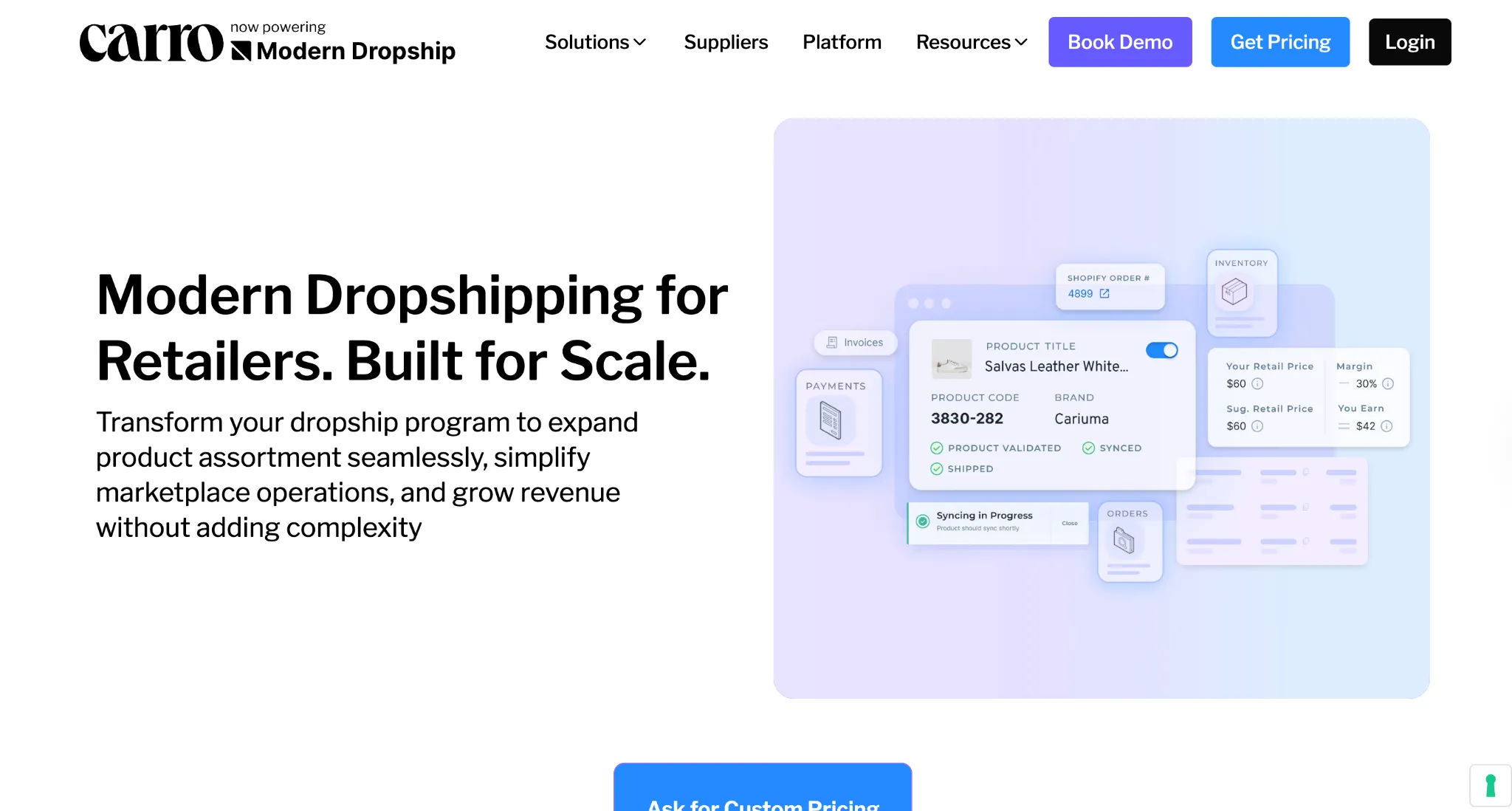
Carro (now powering Modern Dropship) is a dropship platform built specifically for retailers and marketplace operators that want to expand their product assortment without inventory risk.
While Rokt Catalog focuses primarily on helping brands get placed in retail storefronts, we go further by managing the full supplier lifecycle: from onboarding and catalog ingestion to automated order routing, fulfillment tracking, and payout settlement; all from a single platform.
We connect retailers to a network of over 1.5 million products from vetted brand partners. Retailers in our network report up to 3.5x revenue growth, 180% average order value improvement, and 3x catalog expansion.
We also integrate natively with Shopify, WooCommerce, BigCommerce, and Magento, with EDI and SFTP support for more complex enterprise requirements.
Ideal For
- Retailers looking to expand their catalog without purchasing or warehousing inventory
- Online marketplace operators managing multiple brand and distributor partners
- Brands looking to reach new retail distribution channels without wholesale friction or inventory exposure
- Ecommerce teams that need end-to-end supplier orchestration, not just a catalog connection
Top Features
- Hand-Matched Supplier Network: Our account managers actively match retailers with brand partners that fit their catalog and audience. Teams gain access to 1.5M+ products from vetted brands, with human curation ensuring product relevance - not just availability. No other platform on this list replicates this model.
- Automated Order Routing and Fulfillment Orchestration: Orders for partner products are automatically routed to the correct supplier, with SLA tracking and fulfillment performance monitoring built in. Teams do not manage orders manually once the workflow is configured.
- Real-Time Sync Across Commerce Stacks: Product information, pricing, and inventory update automatically across all connected channels. Shopify, WooCommerce, BigCommerce, Magento, EDI, and SFTP are all supported, making alternatives to Rokt Catalog integrations accessible without custom development.
- End-to-End Payout Settlement: Automated payouts to brand partners run on schedule, removing the reconciliation overhead and payout delay issues that some Rokt Catalog users have flagged.
Why We're the Best Rokt Catalog Alternative?
Rokt Catalog connects brands to retailers within a fixed network; passively and without operational infrastructure. Our platform provides the infrastructure for both sides. Retailers get a curated brand network, automated order flows, and proven revenue results. Brands get access to vetted retailers whose audiences align with their positioning, without building individual retail integrations.
The contrast is most visible in operational depth. Rokt Catalog handles catalog placement. Carro handles the entire supplier lifecycle: partner sourcing, catalog sync, order routing, fulfillment tracking, and automated payouts – all in one platform.
Moreover, our revenue-share pricing model (starting at 5% of sales) also stands in direct contrast to Rokt Catalog's opaque cost structure and the enterprise-tier pricing of most alternatives on this list.
Pros
- Purpose-built for inventory-free catalog expansion; not a passive brand distribution tool
- Hand-matched supplier network with 1.5M+ products - the only platform here that actively finds partners for you
- Proven results: up to 3.5x revenue growth, 180% AOV growth, 3x catalog expansion
- Reliable, automated payout settlement; no delayed or missed payouts
- Revenue-share pricing starting at 5% of sales; no per-transaction fees or long-term contracts
Cons
- Not designed for teams that need heavy EDI compliance management across hundreds of existing retail trading partners
- Less suited for brands focused purely on passive retail distribution without operational involvement
- Teams that only need product feed export to advertising channels (Google Shopping, Meta) may find a simpler tool sufficient
Pricing
Carro uses a revenue-share model. The ‘Standard’ Plan is 5% of sales and includes Shopify, Magento, BigCommerce, and WooCommerce integrations plus end-to-end dropship automation. Note that Standard does not include a support plan.
The ‘Growth’ Plan adds autonomous merchandising, a hand-matched supplier network, priority support, automated order routing, real-time sync, and seamless catalog expansion.
All plans include unlimited transactions, full platform access, automated payments, basic performance insights, and access to 1.5M+ products from top brands.
Final Verdict
For retailers and marketplace operators that want to grow their assortment and revenue without inventory exposure, Carro is the most complete option on this list.
For brands that want to reach new retail distribution channels with minimal operational overhead, our platform also provides a meaningful upgrade over Rokt Catalog's narrow placement model, making it the strongest overall Rokt Catalog alternative for teams at any stage.
2. Feedyio
Overview
Feedyio is a Shopify-native product feed management app developed by happyapps.cz. It is designed for Shopify merchants that need to distribute product data - in XML, CSV, and TXT formats - to marketplaces, price comparison sites, and advertising channels from a single place. With 108 reviews and a 5.0-star rating on the Shopify App Store, Feedyio is among the highest-rated feed management tools in its category.
It includes 100+ predefined feed templates for platforms including Google Merchant Center, Meta, Pinterest, TikTok, Awin, Idealo, Trovaprezzi, Kelkoo, and dozens of regional marketplaces. It also supports Shopify Markets for multilingual and multi-currency store operations.
While Feedyio is not a dropship or supplier network tool in the way Rokt Catalog or Carro is, it addresses a specific overlap: brands and retailers that need to distribute their product catalog to external sales channels efficiently and without manual reformatting.
Ideal For
- Shopify merchants distributing product data to Google Shopping, Meta Catalogs, TikTok, Pinterest, and regional marketplaces
- Ecommerce brands managing multilingual and multi-currency product feeds across international markets
- Teams that need to generate custom XML, CSV, or TXT feeds for affiliate networks, price aggregators, or catalog integrations
- Merchants that want a fast, no-code feed setup without developer involvement
Top Features
- 100+ Predefined Feed Templates: Feedyio includes pre-configured templates for every major advertising and marketplace channel - Google Merchant Center, Facebook, Instagram, TikTok, Pinterest, Awin, Idealo, and more. Teams select a template, map their Shopify product attributes, and publish without building custom feed structures.
- Custom XML/CSV/TXT Feed Builder: For platforms without a predefined template, Feedyio's Liquid-based editor allows teams to create fully custom feeds. Metafields and metaobjects can be included in feed outputs, giving product teams control over every attribute without relying on developers.
- Automatic Sync with Shopify Markets: Feedyio generates feeds in multiple languages and currencies based on the store's Shopify Markets setup. Teams managing cross-border ecommerce distribute localized product content to each market's relevant channels without maintaining separate feeds per region.
Why It's a Strong Rokt Catalog Alternative?
Feedyio is one of the strongest options among major Rokt Catalog alternatives for Shopify merchants whose primary need is product data distribution rather than a full dropship or marketplace infrastructure.
For brands that used Rokt Catalog primarily to get their product catalog in front of retail audiences, Feedyio addresses a parallel use case: distributing product data to advertising and marketplace channels at scale, at a far more accessible price point.
Pros
- 5.0-star rating with 108 reviews on the Shopify App Store - one of the highest-rated tools in its category
- Free plan available; paid plans start at $9.99/month - most accessible pricing on this list
- 100+ predefined templates eliminate the need for custom feed development
- Supports multilingual and multi-currency feeds via Shopify Markets integration
- 7-day free trial available; no credit card required
Cons
- Feed export tool only - no dropship supplier network, order routing, or supplier payout management
- Does not help retailers expand their product assortment through new brand partnerships
- Less relevant for teams that need a full distributed commerce or marketplace infrastructure layer
- Template coverage is strong for European markets but may require custom builds for niche regional platforms
Pricing
Feedyio has a clear tiered model, starting with a free plan and then Basic at $9.99/month, Advanced at $19.99/month, and Pro at $29.99/month. Higher tiers unlock more products, feeds, and market coverage, so the pricing scales with usage.
Final Verdict
Feedyio is well-suited for Shopify merchants that need efficient, multi-channel product feed distribution at an accessible price. It is a strong match for brands that want to replace Rokt Catalog's distribution function with a more flexible, channel-agnostic feed tool.
For retailers needing inventory-free catalog expansion or supplier network access, Carro is the better fit.
3. Akeneo
Overview
Akeneo is a Product Experience Management (PXM) platform used by over 900 brands, manufacturers, distributors, and retailers to centralize, enrich, and distribute product data across all sales channels.
Founded in France and used globally, Akeneo serves organizations like Chico's, Steelcase, TaylorMade Golf, and Kering across industries ranging from fashion and luxury to manufacturing and B2B. Akeneo offers both a free open-source Community Edition (built on Symfony) and paid SaaS tiers for teams that need managed infrastructure, enterprise features, and AI-assisted content enrichment.
It is one of the most recognized names in the product information management (PIM) category, and a relevant consideration for teams evaluating alternatives to Rokt Catalog from the product content management angle.
Ideal For
- Mid-market to enterprise brands managing large, complex product catalogs across multiple regions and channels
- Manufacturers and distributors that need to enrich and standardize product data before distributing to retail partners
- Teams with multilingual product catalogs that need localization support at scale
- Organizations that want a PIM with a large partner ecosystem and proven enterprise credentials
Top Features
- AI-Powered Product Enrichment: Akeneo's generative AI tools generate product descriptions, translate content, and optimize data per channel automatically, reducing the time it takes to get new products ready for distribution.
- Omnichannel Distribution: Product content is adapted for each sales channel destination: ecommerce platforms, marketplaces, print catalogs, or retail partner portals from one centralized system.
- App Marketplace and Integrations: Akeneo's ecosystem includes connectors to most major adjacent technologies including DAM platforms, ecommerce platforms, CRMs, and ERPs, giving teams flexibility in how they connect product data to downstream channels.
Why It's a Strong Rokt Catalog Alternative?
Akeneo is one of the stronger choices among Rokt alternatives for teams that used Rokt Catalog primarily to manage and distribute product content to retail partners. Where Rokt Catalog handles placement within its network, Akeneo provides the upstream product data infrastructure: centralizing, enriching, and governing the product content that feeds any distribution channel, whether that is Rokt, a retailer portal, or a marketplace.
Pros
- Free Community Edition available for teams with developer resources
- AI-powered content enrichment and channel-specific data adaptation
- Large ecosystem of technology partners and connectors
- Strong localization support for international catalog management
- Proven at enterprise scale with a large, active customer community
Cons
- Initial setup is complex and may require external implementation support
- Paid tiers (Growth and Enterprise) are custom-priced and can be significant for mid-market teams
- Not a dropship or supplier network tool - does not manage orders, fulfillment, or payouts
- Support quality has been noted as inconsistent in some user reviews
Pricing
Akeneo’s pricing starts at $45,000 yearly under the “Growth” plan, whereas the other 2 tiers (Premium and Advanced) are custom-quoted based on catalog size, channels, and features. Implementation costs through a certified partner are additional.
Final Verdict
Akeneo is a well-suited option for mid-market and enterprise organizations that need a mature, AI-assisted product information management system as the upstream layer for their retail distribution strategy. For teams looking to actually expand their product assortment through new supplier relationships or automate dropship operations, Carro is the more relevant starting point.
4. Rithum
Overview
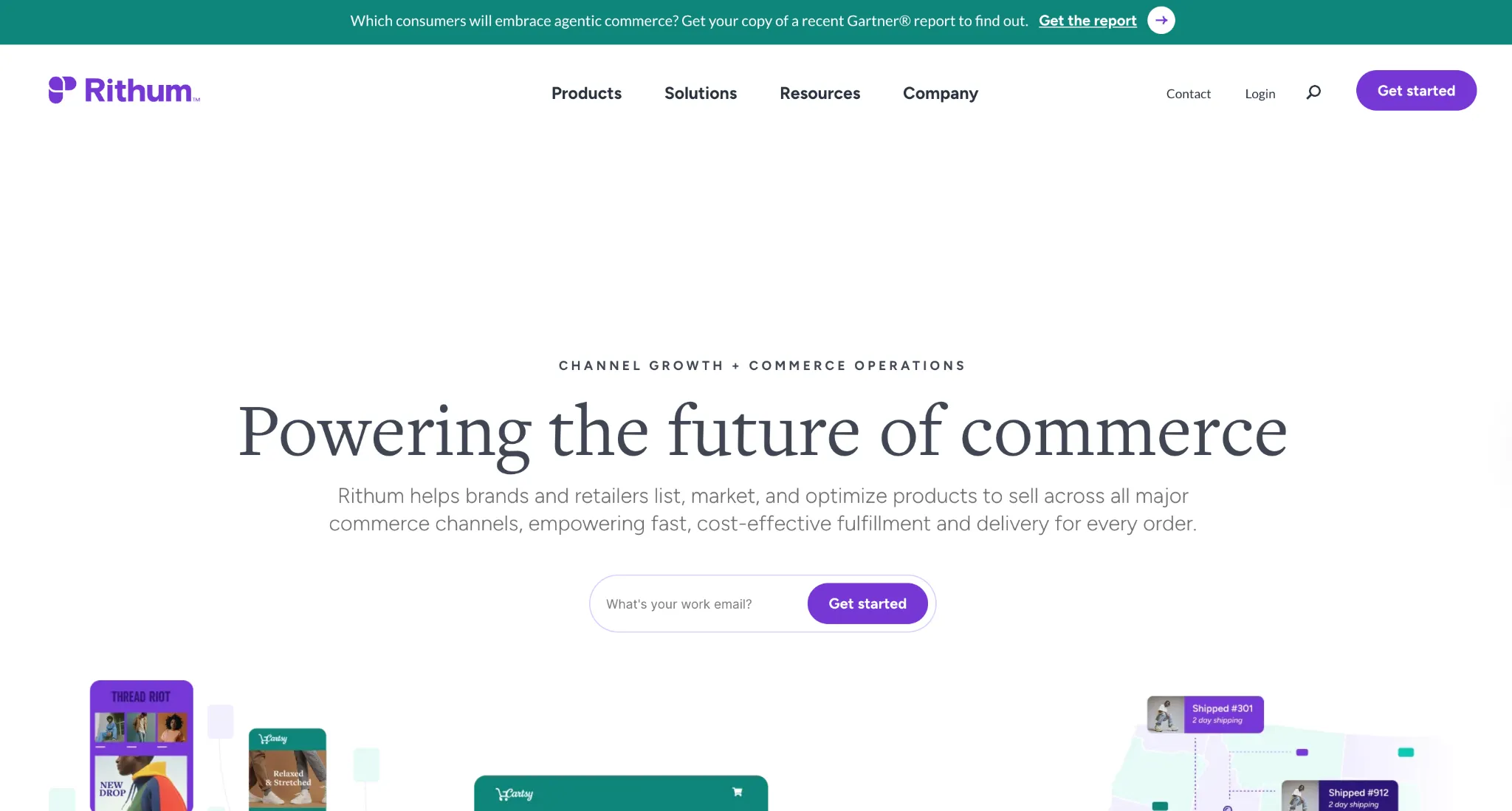
Rithum is the commerce operations platform formed by the merger of CommerceHub and ChannelAdvisor in 2022, rebranded in December 2023. It processes $50 billion in annual GMV for over 40,000 global brands, retailers, and suppliers across 420+ marketplaces and retail channels.
Rithum supports dropship programs, private marketplace vendor management, first-party channel operations, retail media, and product content distribution from one platform. Clients include Adidas, Best Buy, The Home Depot, and Zalando. In September 2025, Rithum launched RithumIQ - an embedded AI engine providing automated recommendations and operational insights across commerce workflows.
Ideal For
- Enterprise brands and retailers managing listings, orders, and performance across dozens of marketplace channels simultaneously
- Organizations that want dropship, private marketplace, and retail media managed in one platform
- Retail buying teams that need supplier performance analytics alongside operational management
- Businesses that have outgrown basic dropship tools and need enterprise-grade multichannel infrastructure
Top Features
- 420+ Marketplace and Retail Channel Connections: Rithum connects brands and retailers to one of the most extensive channel networks available - covering Amazon, Walmart, Best Buy, and hundreds more - with product listing management, inventory sync, and order processing handled centrally.
- RithumIQ AI Engine: Launched in 2025, RithumIQ analyzes performance data, surfaces optimization opportunities, and helps teams act on supply chain exceptions without manual investigation.
- Multi-Model Commerce Management: Rithum supports dropship, private marketplace, and first-party channels simultaneously from one platform, giving enterprise operators flexibility to run different programs under one operational setup.
Why It's a Strong Rokt Catalog Alternative?
Rithum is one of the stronger choices among the top Rokt Catalog alternatives for large enterprises that need multichannel commerce operations managed at scale. Where Rokt Catalog focuses on brand-to-retailer catalog placement within its own network, Rithum handles the full operational layer of selling across 420+ external channels - with analytics, listing optimization, and dropship management included.
Pros
- One of the largest commerce channel networks available (420+ channels, $50B GMV)
- Supports dropship, private marketplace, and first-party channels simultaneously
- RithumIQ AI engine embedded in operational workflows
- Deep analytics and performance insights for channel optimization
- Backed by 28 years of combined CommerceHub and ChannelAdvisor expertise
Cons
- Users report significant price increases post-merger, with some citing 4-7x cost increases
- Platform can feel rigid - teams adapt their workflows to fit Rithum rather than vice versa
- Customer support response times have been flagged as inconsistent at scale
- Setup and onboarding described as slow and expensive by multiple reviewers
- Less suitable for mid-market or SMB retailers without enterprise budgets
Pricing
Rithum’s pricing structure prioritizes custom contract basis with GMV-based fees in some configurations. The amount has reportedly increased substantially post-merger. Connect with their sales team for a customized pricing package.
Final Verdict
Rithum is the best Rokt Catalog alternative for large enterprises that need to manage multichannel commerce, retail media, and marketplace programs from one platform at scale. For mid-market retailers or teams looking for accessible pricing and active supplier sourcing, Carro is a more practical starting point.
5. Feedonomics
Overview
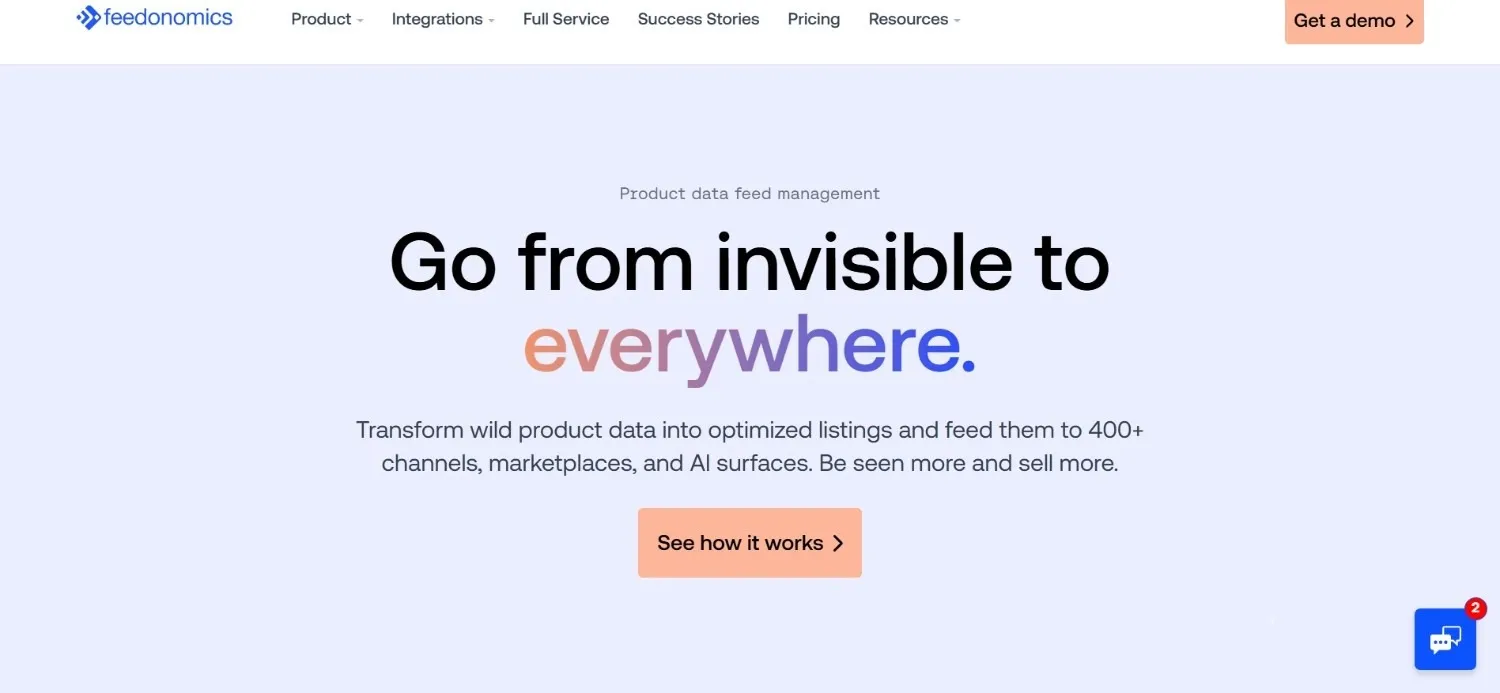
Feedonomics, powered by Commerce, is a full-service product feed management platform that transforms how businesses manage and distribute product data across 300+ channels, marketplaces, and AI-driven discovery surfaces.
Founded in 2014, it pairs a flexible technology platform with a dedicated team of feed specialists who handle catalog optimization, integration setup, feed refresh scheduling, and ongoing maintenance.Brands like Cole Haan, Perry Ellis, Puma, and Revelyst use Feedonomics to improve ROAS, increase reach, and manage product listings across Google Shopping, Amazon, Meta, Walmart, TikTok, eBay, and hundreds of other channels.
Feedonomics exports over 1 trillion rows of data monthly and executes 100 million+ data transformations each month, making it one of the most operationally capable feed management tools available.
Ideal For
- Mid-market to enterprise brands and agencies managing product data across multiple marketplaces and advertising channels simultaneously
- Teams with large, complex catalogs that need expert-led optimization alongside self-serve tooling
- Ecommerce businesses that want 24/7 global feed specialist support rather than a purely self-service tool
- Organizations managing order management alongside feed syndication across marketplace channels
Top Features
- Full-Service Feed Management with Dedicated Specialists: Unlike self-serve alternatives, Feedonomics pairs its platform with a team of channel and integration specialists. Feed managers handle setup, optimization, error resolution, and ongoing maintenance – freeing internal teams to focus on commercial decisions rather than data wrangling.
- 300+ Channel Exports with AI-Enriched Data: Feedonomics imports product data from any source: CSV, XML, JSON, URL, FTP, API; transforms and optimizes it using AI enrichment, and exports channel-specific listings to 300+ destinations including Google, Amazon, Meta, Walmart, TikTok, and emerging AI discovery surfaces.
- Data Governance and Automated Error Prevention: Feedonomics enforces 1.6 million+ data governance rules monthly, automatically detecting unusual raw data changes and preventing bad exports before they impact live listings. This protects ad spend and listing performance across all connected channels simultaneously.
Why It's a Strong Rokt Catalog Alternative?
Feedonomics is one of the strongest choices among Rokt Catalog alternatives for brands that need broad, optimized product data distribution across advertising and marketplace channels with expert support.
Where Rokt Catalog provides brand placement within its own curated retailer network, Feedonomics provides the infrastructure and expertise to distribute optimized product data to 300+ channels – with AI enrichment and governance protecting listing quality at scale.
Pros
- Full-service approach with dedicated specialists - not self-serve only
- 300+ channel exports including Google, Amazon, Meta, Walmart, TikTok, and AI discovery surfaces
- Handles 1T+ rows of data monthly with AI enrichment and 1.6M+ governance rules enforced
- 24/7 global support coverage across time zones - particularly noted by enterprise users
- No percentage of revenue taken - pricing based on SKUs, channels, and service level
Cons
- No publicly disclosed pricing; custom quote required for all tiers
- Steeper learning curve for the self-serve interface; many users rely on specialists to manage it
- Not a dropship or supplier sourcing tool; does not manage orders, fulfillment, or payouts
- Some users report that the GUI is complex to navigate independently
Pricing
Pricing is custom and quote-based, usually tied to SKU count, channels, and the level of managed service. It doesn’t use revenue-share pricing, and it’s positioned more for enterprise or high-volume sellers.
Final Verdict
Feedonomics is a well-suited option for mid-market to enterprise brands that need expert-supported, AI-enriched product feed management across a broad channel network.
For teams coming from Rokt Catalog and looking specifically for multichannel product data distribution with professional support, it is one of the strongest options available. For retailers that also need to source new brand partners and automate supplier operations, Carro covers those needs directly.
6. Mirakl
Overview
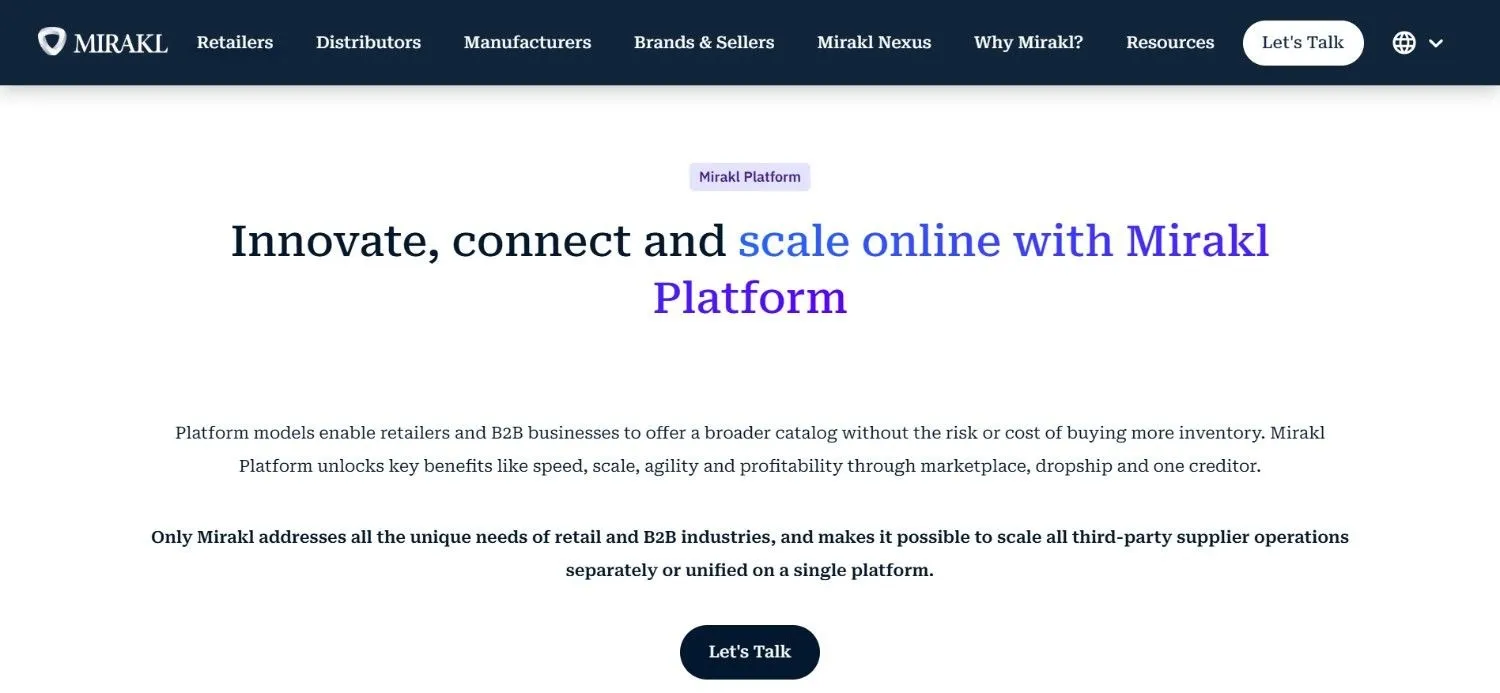
Mirakl is an enterprise marketplace platform that helps large retailers and B2B organizations launch, operate, and scale third-party seller marketplaces. Founded in 2012 and headquartered in Paris and Boston, it is used by major retailers including Best Buy, Macy's, Carrefour, H&M, and Leroy Merlin to power their own first-party marketplace programs.
Mirakl provides the infrastructure for retailers to bring external sellers onto their ecommerce site; managing seller onboarding, catalog listing compliance, order routing, seller performance, and buyer experience through a dedicated marketplace management layer that sits alongside the retailer's existing commerce stack.
Ideal For
- Large enterprise retailers adding a third-party seller capacity to their existing ecommerce storefront
- B2B organizations launching internal procurement marketplaces or supplier portals
- Retailers that want AI-powered catalog quality management and seller compliance scoring
- Organizations with dedicated marketplace teams and the budget for enterprise marketplace infrastructure
Top Features
- Third-Party Seller Onboarding and Management: Mirakl provides a complete seller management layer: onboarding, catalog upload, listing compliance scoring, order routing, and performance management – through a dedicated marketplace workspace.
- AI-Powered Catalog Scoring and Compliance: Mirakl's AI tooling evaluates incoming seller catalog submissions for completeness, accuracy, and compliance before listings go live, reducing manual review burden on marketplace merchandising teams.
- 450+ Platform Connectors: Mirakl integrates with leading commerce platforms, ERPs, payment processors, and logistics systems, letting retailers embed the marketplace layer into their existing stack without rebuilding infrastructure.
Why It's a Strong Rokt Catalog Alternative?
Mirakl is one of the stronger choices among alternatives to Rokt Catalog for enterprise retailers looking to build a fully controlled, branded third-party seller marketplace on their own storefront. Where Rokt Catalog places brand products within a pre-existing retail network, Mirakl gives retailers the infrastructure to run their own seller marketplace with AI-driven catalog governance and full operational control.
Pros
- Purpose-built for first-party marketplace operation at enterprise scale
- AI-powered catalog scoring reduces manual review of seller submissions
- Trusted by major global retailers including Best Buy, Macy's, and H&M
- 450+ platform connectors for deep integration with existing commerce stacks
- Strong product roadmap and continuous platform investment
Cons
- Enterprise pricing; not accessible for SMB or growth-stage businesses
- Significant implementation complexity and timeline
- Overkill for retailers that need dropship automation rather than a full marketplace build
- Customer support feedback is mixed at enterprise scale
Pricing
Mirakl’s pricing usually scales with your gross merchandise volume (GMV). You’ll need to connect with their sales team to get an idea about the ideal price range in detail. There are extra implementation costs as well, with the process requiring engagement with a Mirakl-certified partner.
Final Verdict
Mirakl is the right choice for large enterprises with the budget, team resources, and strategic commitment to operate a third-party seller marketplace on their own storefront. For teams focused on inventory-free assortment expansion through curated brand partnerships, Carro addresses that need more directly and at a far more accessible price point.
7. ShipStation
Overview
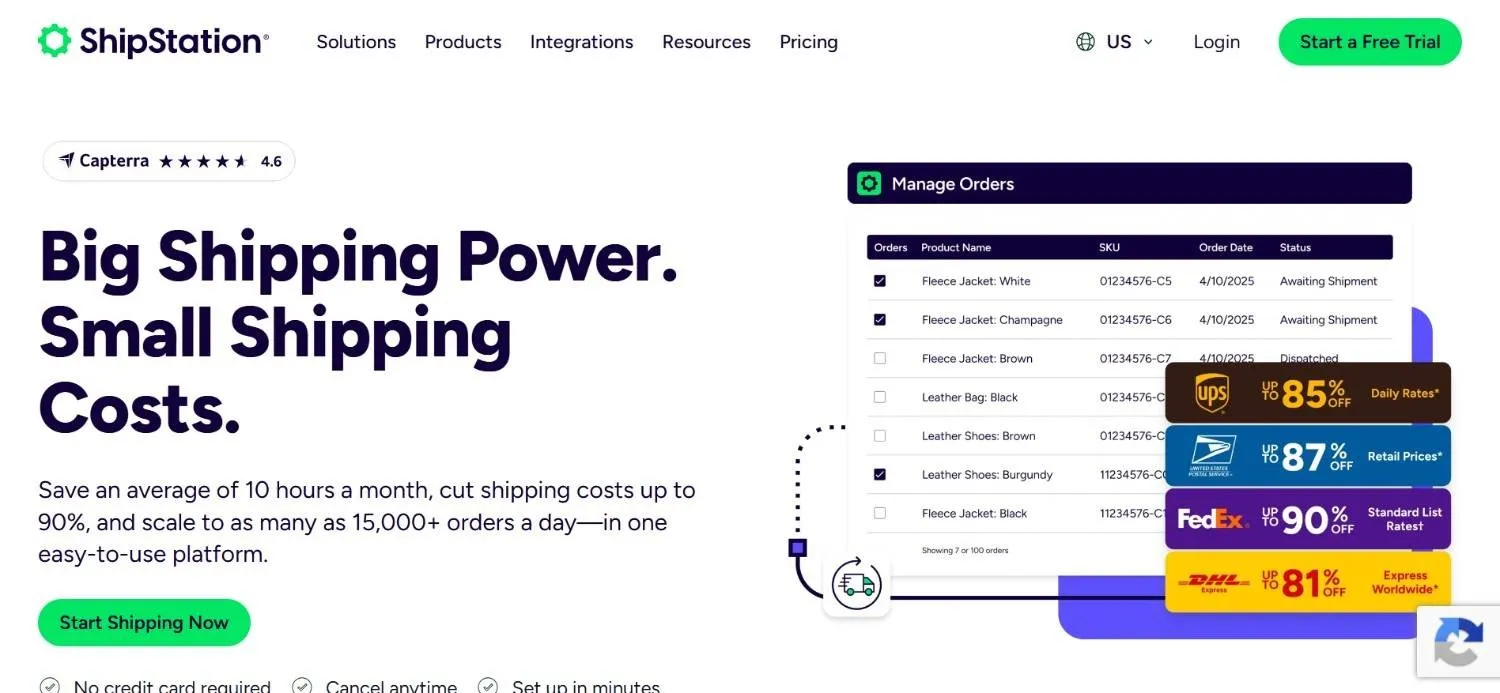
ShipStation is a multi-carrier shipping and order management platform used by SMBs and growing ecommerce businesses to streamline order fulfillment. Founded in 2011 and headquartered in Austin, Texas, it integrates with 400+ carriers, 100+ selling channels, and major ecommerce platforms including Shopify, WooCommerce, BigCommerce, Amazon, and Walmart.
ShipStation is the highest-rated tool in G2's list of top Rokt Catalog alternatives as of 2026, based on reviewer data. Its core focus is on the fulfillment and shipping layer of ecommerce - not catalog distribution or dropship supplier networks - but it addresses a common operational gap for brands and retailers managing multi-channel order volumes.
Ideal For
- SMBs and mid-market retailers managing shipping and fulfillment across multiple sales channels from one dashboard
- Ecommerce teams that need discounted carrier rates, branded tracking pages, and automated shipping rules
- Brands that want to consolidate their multi-carrier shipping operations without building custom integrations per carrier
- Teams looking for an accessible, well-supported fulfillment tool with a genuine free trial period
Top Features
- 400+ Carrier Integrations with Discounted Rates: ShipStation connects to all major carriers - UPS, FedEx, USPS, DHL, and more - with pre-negotiated discounted rates available directly within the platform. Teams compare rates across carriers per shipment without manually checking each carrier's portal.
- Branded Tracking and Customer Notifications: ShipStation provides branded tracking pages and automated email and SMS notifications for customers. Post-purchase customer experience remains consistent and on-brand regardless of which carrier handles a given shipment.
- Multi-Channel Order Sync and Automation Rules: Orders from all connected channels flow into a single dashboard. Automation rules handle carrier selection, packaging assignment, and shipping label generation based on custom criteria - reducing manual touchpoints per shipment.
Why It's a Strong Rokt Catalog Alternative?
ShipStation is a credible option among rokt catalog alternatives for brands and retailers whose primary concern after moving away from Rokt Catalog is operational fulfillment management. It does not replicate the catalog distribution or dropship supplier network functions of Rokt Catalog - but for teams that need a reliable, multi-channel fulfillment layer with broad carrier coverage and accessible pricing, it addresses a real operational need.
Pros
- 400+ carrier integrations with discounted rates available from day one
- User-friendly interface praised consistently in user reviews
- 30-day free trial - one of the longest in this category
- Affordable entry pricing at $9.99/month
- Broad selling channel support: Shopify, Amazon, Walmart, eBay, WooCommerce, and more
Cons
- Shipping and fulfillment tool only - not a catalog distribution, dropship, or supplier network platform
- Does not help retailers expand their product assortment or connect with new brand partners
- Some users report that advanced features and reporting require higher-tier plans
- Automation rules can be complex to configure for teams without dedicated operations staff
Pricing
ShipStation starts at $9.99/month for the Starter plan. Plans scale based on shipment volume and feature requirements. A 30-day free trial is available.
Final Verdict
ShipStation is well-suited for ecommerce teams that need a reliable, scalable multi-carrier fulfillment tool with accessible pricing and a generous free trial. For teams looking for a direct functional replacement for Rokt Catalog's catalog distribution or dropship network capabilities, other options, particularly Carro or Feedonomics are more relevant matches.
8. Logicbroker
Overview
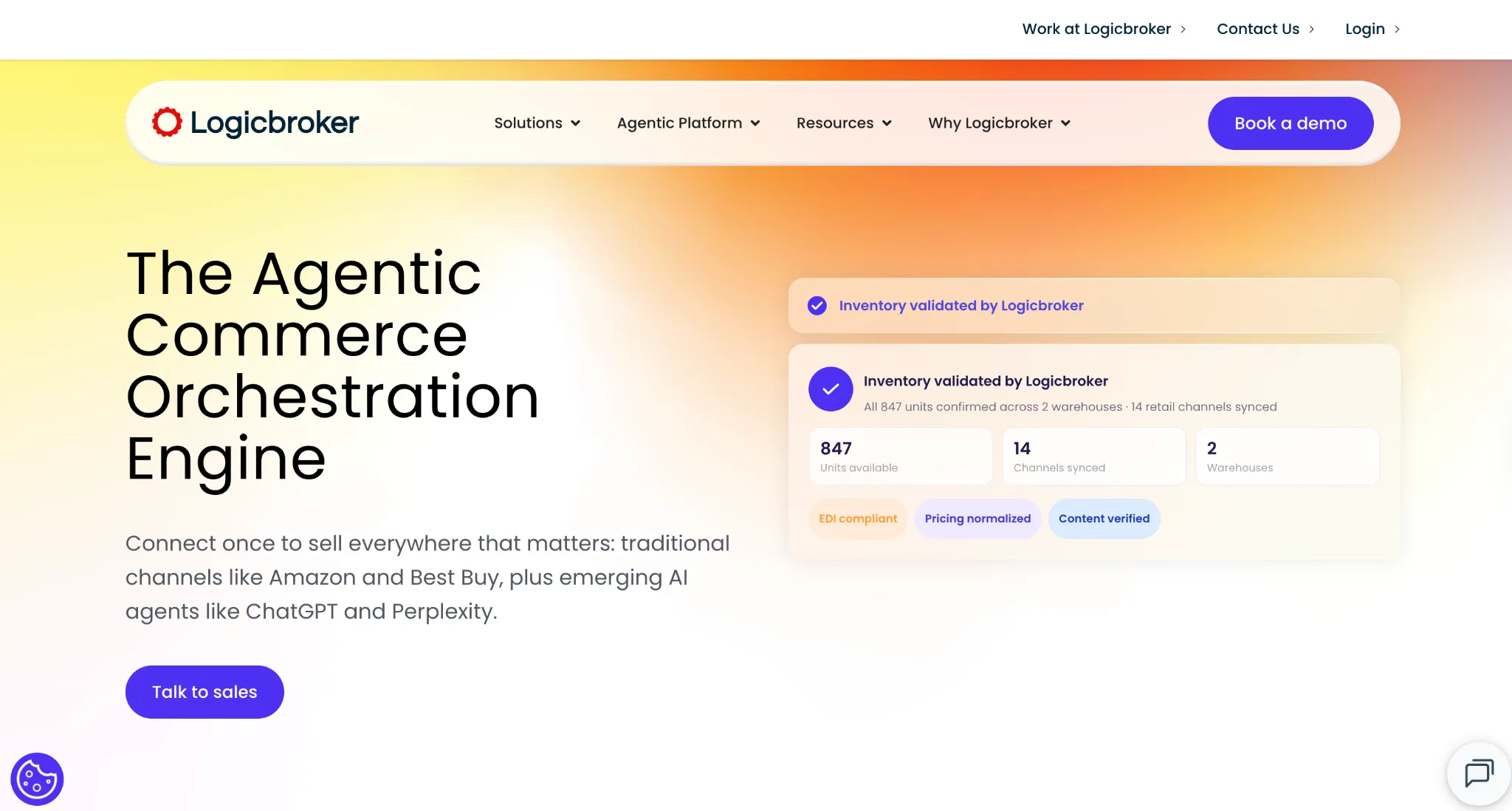
Logicbroker is an enterprise commerce orchestration platform that manages dropship and marketplace programs through EDI, API, XML, CSV, JSON, and FTP integration formats. It processes more than $10 billion in GMV annually for major retailers including Samsung, Walgreens, and Home Depot. Its Azure-based infrastructure operates at 99.9% uptime, and its supplier portal can onboard new trading partners in under an hour.
In recent updates, Logicbroker added agentic AI tooling that handles tasks like stockout prediction, automated order rerouting, and fraud detection without manual intervention. It is one of the most technically capable enterprise dropship orchestration platforms available.
Ideal For
- Enterprise retailers managing complex dropship programs across many trading partners with different integration format requirements
- Organizations that need AI-powered exception management for high-volume order flows
- Large retailers that already have defined supplier relationships and need integration infrastructure to manage them at scale
- Businesses requiring strict compliance, SLA management, and fulfillment performance tracking across distributed networks
Top Features
- Multi-Format Integration Support (EDI, API, XML, CSV, JSON, FTP): Logicbroker connects to trading partners using any integration format they support, without requiring suppliers to change their technical setup. This makes it one of the most flexible platforms for connecting to diverse existing supplier ecosystems.
- Agentic AI for Exception Management: Logicbroker's AI tooling handles stockout prediction, automated order rerouting, and fraud detection in real time - reducing manual intervention in high-volume, complex fulfillment environments.
- Supplier Portal with Fast Onboarding: New trading partners can be onboarded through the supplier portal in under an hour, with all compliance, SLA, and integration requirements structured into the onboarding workflow.
Why It's a Strong Rokt Catalog Alternative?
Logicbroker is one of the most capable choices among the top Rokt Catalog alternatives for enterprise retailers that need a complete, AI-assisted dropship orchestration layer with multi-format integration support. Where Rokt Catalog provides catalog placement within a managed network, Logicbroker provides the integration infrastructure to run a full dropship operation across any supplier using any data format.
Pros
- Handles every major B2B integration format: EDI, API, XML, CSV, JSON, FTP
- Processes $10B+ GMV annually with 99.9% uptime on Azure infrastructure
- AI-powered exception management reduces manual intervention in complex fulfillment environments
- New supplier onboarding in under an hour through the supplier portal
- Trusted by enterprise retailers including Samsung, Walgreens, and Home Depot
Cons
- Pricing is not publicly disclosed; enterprise contracts only - not accessible for mid-market or SMB retailers
- No built-in supplier discovery or partner matching network
- Vendor onboarding for non-technical suppliers can create friction
- Complexity exceeds what most mid-market teams need for straightforward dropship programs
Pricing
Logicbroker follows a custom pricing model, and you’ll need to request a quote based on your business size and other relevant information.
Final Verdict
Logicbroker is well-suited for large enterprises managing complex, multi-format trading partner programs at scale. For most teams evaluating Rokt Catalog alternatives, the complexity and cost make it a poor fit unless you are already operating at enterprise EDI scale.
9. Sellvia
Overview
Sellvia is a US-based dropshipping ecosystem designed for entrepreneurs and solopreneurs who want to launch and operate an ecommerce store without prior technical experience. It includes a curated product catalog, a US-based fulfillment center in Irvine, California, a ready-made store option (Sellvia Pro), automated order fulfillment, pre-written product descriptions and marketing materials, and lifetime one-on-one support.
Sellvia has helped over 500,000 people start dropshipping businesses, according to Capterra. Its core appeal is fast US shipping (1-3 business days), low entry pricing, and an all-inclusive setup that removes most of the technical barriers to starting a dropshipping store. The platform integrates with Shopify and WooCommerce, and offers a 14-day free trial on its base plan.
Ideal For
- Beginner dropshippers and solopreneurs launching their first ecommerce store in the US market
- Entrepreneurs who want a ready-made store with pre-selected products and pre-written marketing materials
- Teams that want fast US-based fulfillment (1-3 days) without building their own supplier relationships
- Sellers looking for an affordable, low-risk entry point into dropshipping with a 14-day free trial
Top Features
- Curated US-Based Product Catalog with Fast Fulfillment: Sellvia's catalog focuses on high-demand, high-margin products shipped from its own US fulfillment center in Irvine, California. Delivery times of 1-3 business days are significantly faster than AliExpress-based alternatives, which typically take 2-4 weeks.
- Ready-Made Storefront (Sellvia Pro): Sellvia Pro includes a fully built, professionally designed online store: complete with product pages, checkout, payment integration, and branding – allowing users to start selling without any web development skills or ecommerce setup knowledge.
- Pre-Written Product Descriptions and Marketing Materials: Every product in the Sellvia catalog includes high-converting product copy, images, and ready-to-use advertising materials. Sellers do not need to write descriptions, source images, or create ad content from scratch.
Why It's a Strong Rokt Catalog Alternative?
Sellvia is a practical option among alternatives to Rokt Catalog for beginner dropshippers and solopreneurs who want a simple, all-in-one entry into ecommerce without the operational complexity of enterprise dropship tools.
While on one hand Rokt Catalog requires brands to have an existing Shopify presence and navigate a retailer placement network, Sellvia gives beginners everything needed to start selling: products, storefront, marketing, and fulfillment, in a single subscription.
Pros
- Fast US-based fulfillment (1-3 days); significantly faster than most dropship alternatives
- Ready-made store option for beginners with no technical background
- Pre-written product descriptions and ad materials reduce setup time
- Lifetime one-on-one support included
Cons
- US shipping only; not suitable for sellers targeting international customers
- Mixed user reviews on billing practices; some report unexpected charges and aggressive upselling during signup
- Limited customization and product catalog flexibility compared to open-model dropship tools
- Less suited for scaling beyond beginner-level operations; catalog depth is more limited than platforms like Carro
- Some users report that platform features feel locked in and difficult to customize independently
Pricing
Sellvia’s custom store offer is marketed at $39/month for a ready-made store setup. Custom design work or premium themes can add extra cost depending on how complex the store is.
Final Verdict
Sellvia is a practical starting point for beginner dropshippers focused on the US market who want an affordable, all-in-one setup without technical complexity.
For experienced retailers or marketplace operators looking to scale their assortment with curated brand partnerships, automated order management, and real-time inventory sync, Carro provides significantly more depth and flexibility.
10. Salsify
Overview
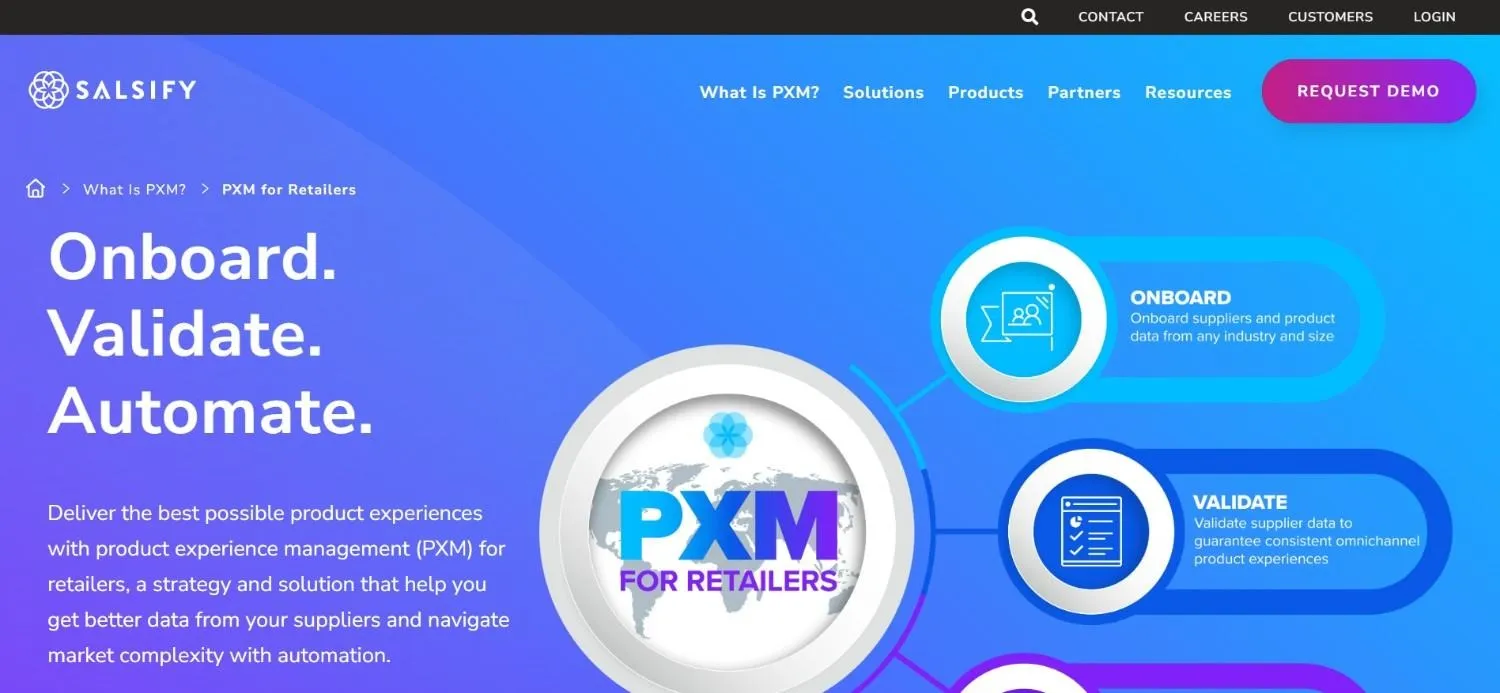
Salsify is a Product Experience Management (PXM) platform that combines PIM, DAM, and content syndication into a unified system. It is particularly well-known for its direct relationships with major retailers and its ability to publish product content to hundreds of retail endpoints from a single platform.
Salsify is used by global brands including Coca-Cola, Bosch, GSK, Rawlings, and Fruit of the Loom, and has been recognized as a Leader in the IDC MarketScape for Product Information Management. For teams evaluating Rokt Catalog alternatives, Salsify is most relevant as an upstream product content management tool for brands distributing product data to retailer portals, marketplace channels, and digital shelf destinations at scale.
Ideal For
- Enterprise brands selling through major retail channels that need direct syndication to retailer portals
- Organizations that want PIM, DAM, and syndication consolidated into one platform
- Teams focused on "winning the digital shelf", managing how products appear across retail endpoints
- Large manufacturers and CPG brands with complex data governance requirements across global markets
Top Features
- PIM + DAM + Syndication in One Platform: Rather than bolting separate tools together, Salsify provides a unified workspace where teams manage product data, digital assets, and content distribution without switching platforms. This reduces integration overhead and improves consistency across the product experience workflow.
- Digital Shelf Analytics: Salsify's Intelligence Suite provides insights into how product content performs across retail channels: visibility scores, content quality, competitor benchmarking; allowing teams to identify gaps and act on them without relying on separate analytics tools.
- Global Retailer Network for Syndication: Salsify maintains direct relationships with retail channels and partners, letting brands distribute product content to hundreds of endpoints through a single workflow rather than managing separate integrations per retailer.
Why It's a Strong Rokt Catalog Alternative?
Salsify is one of the stronger options among major Rokt Catalog alternatives for enterprise brands that need to govern, enrich, and syndicate product content across a broad network of retail channels.
Where Rokt Catalog provides brand placement within its own retailer network, Salsify gives brands the product content infrastructure to distribute optimized, channel-specific content to hundreds of retailer portals, marketplaces, and digital shelf destinations.
Pros
- Combines PIM, DAM, and syndication in one unified platform
- Extensive global syndication network with direct retailer relationships
- Strong AI and automation tooling for content enrichment and workflow acceleration
- Recognized by IDC, Forrester, and G2 as a top enterprise PIM platform
- Real-time collaboration capabilities for cross-functional teams
Cons
- One of the most expensive options on this list; starting cost is reportedly ~$35,000/year minimum
- Onboarding requires a third-party consulting firm and can be time-consuming
- Some users report the interface feels dated and navigation can be slow
- Support response times have been cited as slow by multiple reviewers
- Not the right fit for small or mid-market businesses with limited implementation budgets
Pricing
Not publicly disclosed. Based on user-reported data, the minimum annual commitment is approximately $35,000/year, with implementation costs adding a minimum of ~$16,000 through a required partner. You’ll need to talk to the Salsify sales team for a tailored quote.
Final Verdict
Salsify is best suited for enterprise brands with complex product catalogs, broad retailer channel relationships, and the budget to match. It is one of the most complete platforms for digital shelf management at scale. For mid-market teams or organizations focused on inventory-free catalog expansion rather than product content governance, more accessible options: particularly Carro or Feedonomics, provide better value for the investment.
Why Carro Works Across Multiple Use Cases?
Retailers Expanding Their Assortment
Retailers that want to grow their product range without buying inventory run into the same problem with most tools: the platform connects you to channels or helps you manage data, but does not actually find new brand partners for you.
We solve the sourcing problem directly. Its account managers match retailers with brand partners that fit their existing catalog; so teams expand their assortment and the operational infrastructure to sell it simultaneously.
Retailers report up to 3x catalog expansion and 3.5x revenue growth after adopting the platform, with customers like VYSN who built a scalable brand network on Carro expanding their product assortment across multiple platforms from a single centralized place, without adding operational friction.
Online Marketplace Operators
Marketplace operators managing dozens of brand and distributor partners need a platform that normalizes catalog data, syncs inventory in real time, routes orders to the correct supplier, and processes payouts automatically – without becoming a full-time operational overhead.
We manage all of this from a single dashboard. Operators can onboard new brand partners through structured workflows and scale their supplier network without adding headcount.
Brands Reaching New Retail Channels
Brands that want distribution through established retailers – without wholesale inventory commitments or lengthy negotiation cycles, use our platform to get introduced to retailers whose audiences already align with their product positioning.
Unlike Rokt Catalog, which places brands within a fixed network, Carro actively matches brands with relevant retail partners based on catalog fit and audience alignment. Payouts are automated, and the brand maintains control over which retailers they partner with, what margins they set, and how their products are presented.
Retailers Launching New Marketplace Programs
Retailers adding a dropship or marketplace layer to their existing storefront typically face two obstacles: finding the right supplier partners and building the operational workflow to manage them at scale. We address both.
Native integrations with Shopify, WooCommerce, BigCommerce, and Magento let retailers connect their storefront and begin transacting within days, not months.
Teams Replacing Legacy Dropship Tools
Teams running dropship programs through manual processes, spreadsheets, or aging tools often move to Carro when they need to scale. Its end-to-end automation: catalog sync, order routing, payout settlement – removes the manual touchpoints that limit how far a legacy program can grow without breaking.
What Makes a Good Rokt Catalog Alternative?
Genuine Inventory-Free Growth
A credible Rokt Catalog alternative should do more than place your products in a network. It should give retailers and marketplace operators the infrastructure to actively expand their assortment, automate order flows, and manage supplier relationships at scale – without the operational overhead of traditional wholesale or inventory-based models.
Reliable, Automated Payout Settlement
One of the most cited gaps in Rokt Catalog is payout reliability. Multiple users have reported delayed or missed supplier payments. A genuine alternative must process payouts to brand partners accurately, on schedule, and without manual reconciliation. This is non-negotiable for brands managing cash flow across multiple retail relationships.
Real-Time Inventory Sync Across All Connected Channels
Any platform handling distributed product availability needs real-time inventory accuracy. Stale inventory data causes oversells, order cancellations, and customer experience failures that erode both retailer and brand relationships.
The right Rokt Catalog alternative syncs inventory changes immediately, not on a delay – across every connected storefront and channel.
Operational Depth Beyond Catalog Discovery
Rokt Catalog is a catalog discovery and placement tool. A good alternative (like Carro) goes further: supplier onboarding workflows, SLA management, fulfillment performance tracking, order routing logic, and exception handling should all be part of the operational layer; not add-ons requiring separate tools.
Transparent, Accessible Pricing
Most enterprise alternatives to Rokt Catalog require a sales engagement before you see a number. A genuinely accessible alternative should offer transparent, scalable pricing that does not require an enterprise commitment or mandatory implementation partner to evaluate.
Carro’s revenue-share model and Sellvia's published monthly plans are two examples of pricing structures that teams can evaluate without a procurement cycle.
How to Choose the Right Rokt Catalog Alternative for Your Needs?
1. Identify Whether You Are a Brand or a Retailer
Rokt Catalog served brands primarily. If you are a brand looking for retail distribution, tools like Feedyio, Akeneo, Salsify, and Feedonomics help you distribute and enrich product data for retail channels. If you are a retailer looking to expand your assortment through new supplier partnerships, Carro is the most relevant starting point.
2. Assess Whether You Need Feed Distribution or Supplier Orchestration
Feed distribution tools (Feedyio, Feedonomics) push your existing product catalog to advertising and marketplace channels. Supplier orchestration tools (Carro, Logicbroker, Rithum) manage the operational layer of working with brand partners: catalog ingestion, order routing, payout settlement. These are fundamentally different use cases. Choosing the right tool depends on which problem you are actually trying to solve.
3. Verify Storefront and Commerce Stack Compatibility
Confirm that any shortlisted alternative integrates with your ecommerce platform - Shopify, BigCommerce, WooCommerce, Magento – and with your OMS, ERP, or WMS if applicable. For Shopify-native merchants, Feedyio and Sellvia are purpose-built for the platform. For multi-platform operations, Carro, Feedonomics, and Rithum all support major commerce stacks.
4. Evaluate Total Cost of Ownership Against Your Transaction Volume
Entry pricing is only part of the cost picture. Factor in implementation fees, per-partner or per-channel fees, required consulting partners, and whether pricing scales in proportion to your actual transaction volume.
Carro’s 5% revenue-share model aligns directly with your sales activity. Salsify's $35K+ annual minimum is only justifiable at enterprise scale.
5. Check for Inventory Management Software Compatibility
If your team manages owned inventory alongside dropship or catalog distribution, verify that the platform handles both without requiring separate systems.
Carro handles the dropship and marketplace layer. For teams that also manage owned inventory, pairing Carro with a dedicated inventory management software keeps both models running cleanly without data fragmentation, giving you full visibility across sourced and owned stock in one operational picture.
Everything You Need to Know About Rokt Catalog Alternatives
| Category | Key Considerations |
|---|---|
| Top 3 Alternatives | Carro (best overall for inventory-free assortment expansion); Feedyio (best for Shopify product feed distribution); Feedonomics (best for enterprise multichannel feed management with specialist support) |
| Best Overall Option | Carro; covers inventory-free catalog expansion, hand-matched supplier network, automated order routing, and real-time sync at accessible revenue-share pricing |
| Why Look for Rokt Catalog Alternatives? | Limited operational depth; small partner network; payout reliability concerns; primarily designed for brands not retailers; requires Rokt ecosystem for full value |
| How to Choose | Identify brand vs. retailer use case; assess feed distribution vs. supplier orchestration needs; verify storefront compatibility; calculate total cost against transaction volume |
| Price Range | From $9.99/month (Feedyio, ShipStation) to $39/month (Sellvia) to 5% of sales (Carro) to custom enterprise pricing (Akeneo, Rithum, Feedonomics, Mirakl, Logicbroker, Salsify at $35K+/year) |
| Ease of Switching | Feedyio (7-day trial, Shopify-native) and Sellvia (14-day trial) are easiest to evaluate. Carro connects via native storefront integrations and most retailers are live within days. Salsify and Mirakl require formal implementation projects |
| Must-Have Features | Reliable payout settlement, real-time inventory sync, storefront integration, automated order routing, and pricing that scales with your business model |
| Mistakes You Shouldn't Make | Choosing a feed tool when you need supplier orchestration (or vice versa); overlooking payout settlement reliability; selecting enterprise tooling before your transaction volume justifies the cost |
Ready to Move On from Rokt Catalog? Try Carro
Carro is the only platform on this list that actively sources new brand partners for retailers, manages the full operational layer behind each transaction, and does both with transparent, accessible pricing. Most Rokt Catalog alternatives handle one side of the equation. But none of them find you new supplier partners, manage the catalog-to-payout lifecycle, and give retailers the infrastructure to run a distributed brand network at scale – all in one place.
Our platform is built for US-based retailers and marketplace operators on Shopify, WooCommerce, BigCommerce, and Magento; with no long-term contracts, per-transaction fees, or minimum order requirements. Plus, our team also works closely with you to identify brands that fit your audience, category, and pricing strategy, so you are not just adding more products, you are adding the right products.
Once those partners are onboarded, we take care of everything behind the scenes. Retailers in the Carro network have seen up to 3.5x revenue growth, 180% AOV increase, and 3x catalog expansion. The FairGround scaled their assortment without adding operational headcount by automating inventory management and order routing through the platform.
If you are evaluating a move away from Rokt Catalog, or looking to build a structured dropship or marketplace program from the ground up – Carro is the right starting point. Most US-based retailers working with us go live and transact within a few weeks of activation, with no custom development required.
Book a demo or request custom pricing to get started.
Frequently asked questions
What is Rokt Catalog used for?
Rokt Catalog (formerly Canal) is used for distributed commerce, specifically, helping brands sell their products through a curated network of established retail partners without managing logistics, integrations, or individual retailer relationships. Brands submit their catalog, accept placement proposals from retailers, and Rokt Catalog handles fulfillment coordination and payout processing.
Which is the best Rokt Catalog alternative in 2026?
If your goal is growing your catalog through new brand partnerships, with automated order routing, real-time sync, and reliable payouts, Carro is the most direct solution. It connects US-based retailers and marketplace operators to 1.5M+ products from vetted brand partners, with end-to-end supplier orchestration from a single platform.
What features should I look for in a Rokt Catalog alternative?
When evaluating alternatives to Rokt Catalog, prioritize reliable, automated payout settlement (a documented pain point with Rokt Catalog itself), real-time inventory sync, storefront compatibility, and whether the platform handles supplier orchestration end-to-end or just catalog distribution. If you need to find new brand partners, not just manage existing ones - Carro is the only option on this list that actively sources and matches suppliers for retailers.
How do I choose the best Rokt Catalog alternative for my needs?
Choosing the right Rokt Catalog alternative starts with identifying your role: are you a brand seeking retail distribution, or a retailer seeking to expand your assortment? Feed tools like Feedyio and Feedonomics help brands distribute product data. Supplier orchestration platforms like Carro help retailers build and scale a dropship or marketplace operation. Confirm storefront compatibility, verify payout reliability, and calculate total cost of ownership before committing.
Is it easy to switch from Rokt Catalog to an alternative?
Switching from Rokt Catalog varies by platform. Carro connects to Shopify, WooCommerce, BigCommerce, and Magento via native integrations and most retailers are live within days. Feedyio's Shopify App Store installation takes minutes. Enterprise platforms like Salsify and Mirakl require formal implementation projects. Teams should identify their primary use case first - catalog distribution vs. supplier orchestration, to ensure they choose a platform that actually replaces the right function.
Is Carro better than Rokt Catalog?
Carro and Rokt Catalog serve overlapping but distinct use cases. Rokt Catalog is primarily a brand distribution tool, it places brand products within a fixed retailer network without providing operational infrastructure for managing that network. Carro is an end-to-end dropship and marketplace infrastructure tool that serves both brands and retailers, with automated order routing, real-time inventory sync, hand-matched supplier sourcing, and reliable payout settlement. For retailers and marketplace operators, Carro provides substantially more operational depth.
What is the main difference between Carro and Rokt Catalog?
The main difference between Carro and Rokt Catalog is operational scope. Rokt Catalog places brand products in a curated retail network and handles basic fulfillment coordination, but does not provide suppliers or retailers with the infrastructure to manage a distributed supplier operation at scale. Carro manages the full supplier lifecycle: catalog ingestion, real-time inventory sync, automated order routing, SLA tracking, fulfillment performance monitoring, and automated payout settlement, all from one platform. Carro also actively sources new brand partners for retailers through hand-matched introductions, while Rokt Catalog requires brands and retailers to find each other within the existing Rokt network.
Does Carro work for brands as well as retailers?
Yes. Carro serves both sides of the supplier-retailer relationship. Brands use Carro to expand their retail distribution through vetted retailer introductions, without wholesale inventory commitments, long negotiation cycles, or custom integration work per retailer partner. Retailers use Carro to expand their product assortment through curated brand partnerships without buying or holding inventory. Both sides benefit from automated order routing, real-time sync, and reliable payout processing.
How does Rokt Catalog differ from a traditional dropship platform?
Rokt Catalog differs from a traditional dropship platform in that it operates as a placement network within the broader Rokt ecommerce ecosystem, with product relevance optimized by Rokt Brain AI during the transaction moment.