

How to Grow an eCommerce Business in 2026 (Scale Without Increasing Headcount)
.png)
April 9, 2026

Key Takeaways (TL;DR)
- Scale Smart, Not Big: Learning how to scale an ecommerce business in 2026 is less about hiring more people and more about adopting intelligent systems. The key is to increase revenue and operational capacity without a proportional increase in overhead.
- Collaborative Commerce is the Future: The most powerful way to grow your ecommerce business without bloating your team is through collaborative commerce. Platforms like Carro let you sell products from other top-tier brands on your store, expanding your catalog instantly with zero inventory risk.
- Make Automation Your Ally: From marketing to customer service and fulfillment, AI and automation tools are essential. They handle repetitive tasks, allowing your core team to focus on high-impact growth initiatives.
- Double Down on What Works: Focus on increasing Customer Lifetime Value (LTV) and Average Order Value (AOV). Strategies like loyalty programs, subscription models, product bundles, and conversion rate optimization (CRO) generate more revenue from your existing traffic.
- Prioritize Proven Growth Strategies: - Driving sustainable, profitable traffic is key. Instead of relying solely on ads, diversify with long-term strategies. Focus on SEO for lasting "free" traffic, content marketing to engage your audience, influencer marketing to build authentic connections, and paid media optimization to maximize ad efficiency.
- Experience is Everything: A seamless user experience (UX) is non-negotiable. A fast, intuitive, and mobile-friendly website directly translates to higher conversions and customer satisfaction, forming a core part of any ecommerce growth strategy.
Top Strategies to Scale Your Ecommerce Business: A Quick Comparison
Table of Contents
- Is Your Ecommerce Business Ready for Growth?
- The Biggest Blockers to Scaling an Ecommerce Business
- How to Grow an Ecommerce Business Without Scaling Headcount
- Embrace Collaborative Commerce with Carro
- Additional Tips for Retailers Scaling Their Ecommerce Business
- Scale Smarter with Carro
- Frequently Asked Questions (FAQs)
Is Your Ecommerce Business Ready for Growth?
Before you start implementing new ecommerce growth tactics, it’s crucial to assess if your foundation is solid. Scaling too early can amplify existing problems and lead to disaster.
Imagine pouring water into a leaky bucket - you need to patch the holes first.
So, how do you know it's time to grow your ecommerce business?
Look for these signs:
- Consistent Profitability: You’re not just breaking even; you have a healthy profit margin. This cash flow is the fuel for your growth engine. If every dollar of revenue is eaten up by costs, you're not ready to scale.
- Strong Product-Market Fit: Your products are selling consistently, and you have a clear understanding of who your customer is and why they buy from you. You receive positive reviews, see repeat purchases, and have a low return rate.
- Overwhelmed but Successful: Is your team constantly busy fulfilling orders, answering customer queries, and managing inventory? If you're struggling to keep up with demand, it’s a clear signal that your current systems are at capacity. This is the perfect time to introduce automation and smarter processes, not just more people.
- Predictable Sales Channels: You have at least one or two marketing channels (like SEO, Meta Ads, or email) that reliably bring in customers and sales. You understand your customer acquisition cost (CAC) and can predict how much you need to spend to get a certain number of sales.
If these points describe your business, congratulations.
You’re ready to explore how to scale an ecommerce business effectively.
The Biggest Blockers to Scaling an Ecommerce Business
As you plan your expansion, be aware of the common roadblocks that trip up even the most promising brands.
Recognizing these challenges is the first step to overcoming them.
1. The Inventory Trap: When Your Own Products Hold You Back
Imagine your best-selling product flies off the virtual shelves.
Fantastic, right? But now comes the pressure. You need to order more inventory - a lot more.
This is where growth can paradoxically become your biggest obstacle. Ordering more stock ties up huge amounts of cash that could be used for marketing or innovation. Suddenly, your profits are sitting in a warehouse instead of working for you.
This is the inventory trap.
More sales require more stock, which means higher storage costs, increased insurance premiums, and a more complex fulfillment process.
One wrong forecast, and you're either dealing with a stockout on a viral product (killing your momentum and disappointing customers) or you're stuck with overstocked items that drain your finances and gather dust.
Every dollar tied up in physical inventory is a dollar you can't invest in scaling your brand. It’s a delicate balancing act that trips up countless growing businesses, turning their greatest asset - their products - into their heaviest anchor.
2. Rising Operational Costs: Running Faster Just to Stand Still
More orders should mean more profit, but often it just means more chaos.
Each new sale triggers a cascade of manual tasks: someone has to pick, pack, and ship the order. Someone has to answer the influx of customer service emails about shipping times and order status. And someone has to process the inevitable returns.
The traditional solution? Throw more people at the problem.
But hiring is a costly and slow-moving fix. It balloons your overhead with salaries, benefits, and training costs, steadily eroding your profit margins. Plus, a bigger team adds management complexity, taking your focus away from strategy and putting it on HR.
You find yourself on an operational treadmill, running faster and spending more just to keep up, without actually moving your business forward.
3. Technology Limitations: When Your Tools Can't Keep Up
The tools that got you to your first million in revenue often won't get you to your next. That clean, basic Shopify theme and the handful of apps you installed early on were perfect for a startup, but they can buckle under the strain of high volume.
Suddenly, your website slows to a crawl during a flash sale, costing you thousands in abandoned carts. Your checkout process feels clunky and outdated, causing friction for customers. Your inventory system doesn't sync properly with your marketing tools, leading to embarrassing stockout situations.
You’re hitting a tech ceiling, where your software is no longer a facilitator of growth but a direct barrier to it.
Without a scalable tech stack, every attempt to grow is met with crashes, glitches, and a poor customer experience that can permanently damage your brand reputation.
4. Inefficient Customer Acquisition: When Your Old Tricks Stop Working
For many brands, growth is fueled by one or two reliable marketing channels, like Meta ads or Google Shopping. But what happens when those channels become saturated or the costs skyrocket?
This is the customer acquisition wall, and it's a common and dangerous plateau.
Relying on a single channel is like building your empire on a foundation of sand. Ad costs inevitably rise, algorithms change, and what worked yesterday might be twice as expensive tomorrow. Without a diverse and efficient ecommerce growth strategy, you're stuck in a bidding war you can't win.
To truly scale, you need to find new, profitable ways to attract customers. Otherwise, your growth engine sputters out, and you're left watching your competitors speed past you.
How to Grow an Ecommerce Business Without Scaling Headcount
The dream of every founder is to see revenue climb while costs stay flat.
This isn't a fantasy; it's the result of strategic, system-based thinking.
Here’s how to scale an ecommerce business in 2026 by working smarter, not just hiring more.
1. Embrace Collaborative Commerce with Carro
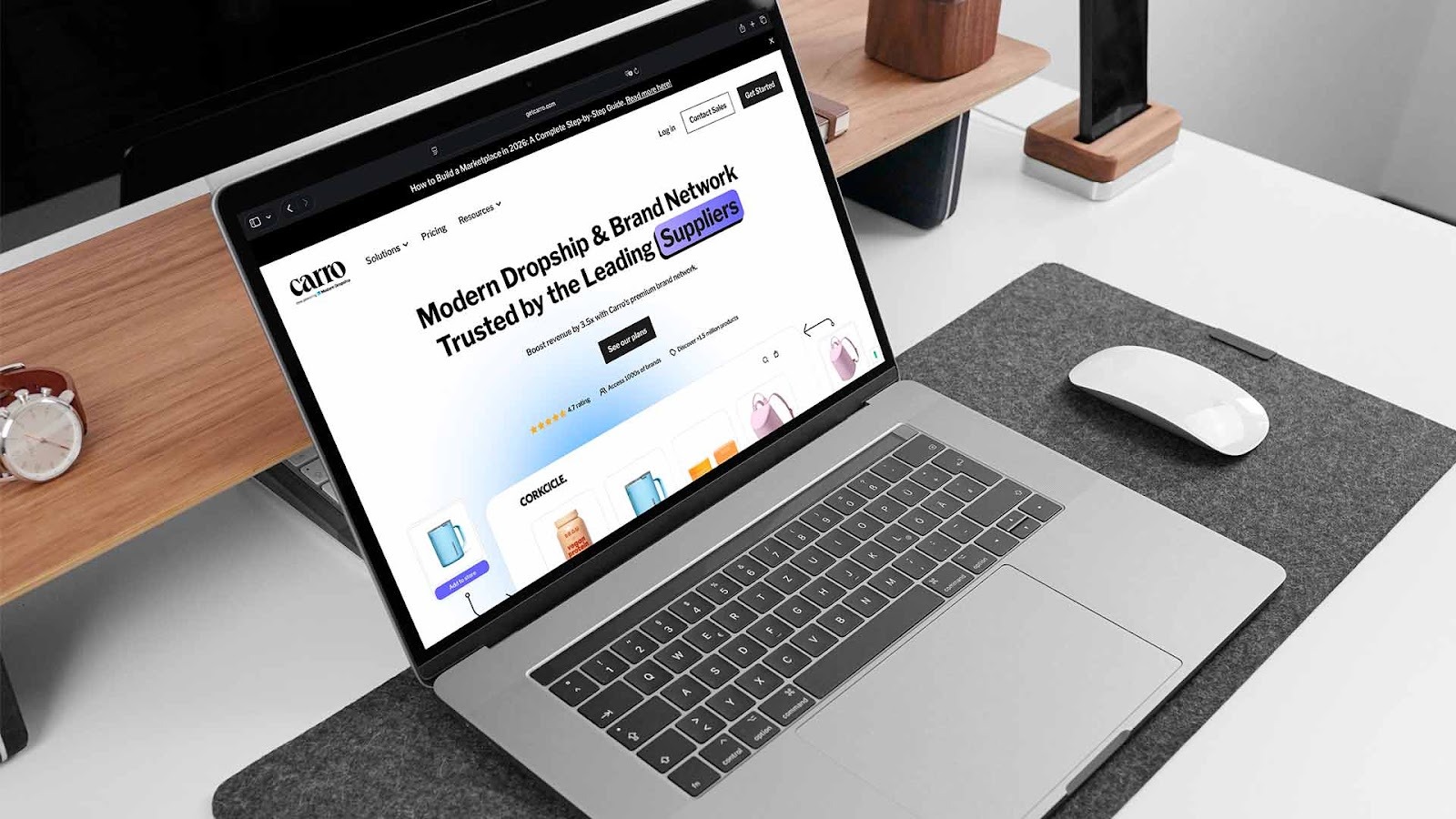
Imagine expanding your product catalog from 50 items to 5,000 overnight. Imagine testing new product categories, colors, and brands without spending a single dollar on inventory.
This is the power of collaborative commerce, and it’s the most transformative way to grow an ecommerce business today.
Traditional retail forces you into a painful cycle: research products, forecast demand, risk capital on inventory, and hope it sells. Collaborative commerce breaks this cycle.
Carro is the leader in this space, offering a platform that connects you with thousands of top-tier brands. You can browse our gigantic product catalog (over 1,500,000 products and counting!) and add complementary products to your online store with a click.
How does it work?
- Discover Products: You find a brand in Carro’s network whose products would appeal to your customers. For example, a swimwear brand could partner with a sunscreen or beach towel company.
- Add to Your Store: You add their products to your online store. All product details, imagery, and inventory levels are synced automatically. To your customer, it looks like just another product you sell.
- A Customer Buys: A customer purchases the partner product from your website.
- Automated Fulfillment: The order is automatically routed to the supplier brand. They pick, pack, and ship the product directly to your customer.
- You Get Paid: You earn the margin between your retail price and the supplier's wholesale cost. Carro automatically deducts their platform fee (5-7% depending on your plan) from each sale. You receive regular payouts for your profits - no inventory investment required.
This model is a game-changer for scaling. It allows you to:
- Instantly Increase Average Order Value (AOV): By offering relevant, complementary products, you encourage customers to add more to their cart.
- Test New Markets with Zero Risk: Want to see if your customers are interested in wellness products, pet accessories, or home goods? Add a few from a Carro partner and see what sells. If it doesn't work, you've lost nothing.
- Diversify Your Revenue Streams: You are no longer solely dependent on the sales of your own products. This provides a buffer against seasonality or changing trends.
- Enhance Your Brand's Value: By curating a selection of high-quality products from other great brands, you become a trusted lifestyle destination, not just a single-product store.
Instead of hiring a massive buying and merchandising team, you can leverage Carro to become an expert curator, offering a vast, dynamic catalog managed by a lean team.
2. Invest in AI and Automation

Artificial intelligence is no longer a futuristic buzzword; it's a practical tool for automating the repetitive tasks that bog down your team.
To scale your ecommerce business, you must delegate as much as possible to technology.
Customer Service Automation
Imagine your customer support team spending their entire day answering the same five questions: "Where is my order?" or "What’s your return policy?".
It’s draining, repetitive, and frankly, inefficient.
AI-powered chatbots can now handle up to 80% of these common inquiries instantly. By integrating tools like Gorgias or Intercom, you provide your customers with the immediate gratification they crave while freeing up your human agents to tackle complex, high-value conversations that require a personal touch.
These platforms don't just talk; they act.
They can automate entire processes like returns and exchanges without a single manual click, allowing your team to focus on building real relationships rather than managing tickets.
Marketing Automation
Your marketing should work for you while you sleep.
Utilizing platforms like Klaviyo or Omnisend allows you to build sophisticated email and SMS flows that guide customers through their entire journey.
From automated welcome series that build brand affinity to abandoned cart reminders that recover lost revenue, automation ensures no opportunity slips through the cracks.
Today’s AI takes it a step further, analyzing customer behavior to determine the precise moment to send a message and exactly which product recommendations will convert a browser into a buyer.
AI-Powered Content Creation
In the world of e-commerce, content is king, but producing it at scale can be an uphill battle for lean teams. Generative AI tools are the solution, acting as a force multiplier for your marketing department.
These tools can rapidly generate SEO-optimized product descriptions, punchy ad copy, and comprehensive blog outlines. This allows a small team to maintain a massive content presence, driving organic traffic and keeping your brand at the forefront of your customers' minds without the burnout of manual drafting.
Warehouse & Fulfillment Automation
While high-end robotics might seem like a distant dream, meaningful automation in fulfillment is accessible right now. By implementing smart software, you can eliminate the manual bottlenecks that slow down your shipping process.
Automate the generation of picking lists, batch-print shipping labels, and trigger instant tracking updates the second a package leaves the dock. These steps can streamline your operations and save valuable time.
If you’re working with a 3PL, ensure they are leveraging modern, automated systems. The goal is a seamless, "hands-off" flow from the moment a customer clicks "buy" to the moment the package arrives at their door.
3. Obsess Over Your User Experience (UX)

Your website is your 24/7 salesperson.
If it’s slow, confusing, or broken on mobile devices, you are losing sales. Optimizing your UX is one of the highest-leverage activities you can undertake. A great experience increases conversions, which means you make more money from the traffic you already have.
Focus on these key areas:
- Site Speed: Every second counts. A 1-second delay in page load time can lead to a 7% reduction in conversions. Use Google's PageSpeed Insights to diagnose issues. Compress images, leverage browser caching, and consider upgrading your hosting plan.
- Mobile-First Design: Over 60% of ecommerce traffic comes from mobile devices. Your site shouldn't just be "mobile-friendly"; it should be designed for the mobile experience first. This means large buttons, simple navigation, and a streamlined checkout process that is easy to complete on a small screen.
- Simplified Navigation: Can customers find what they are looking for in three clicks or less? Use clear menu categories, a prominent search bar with auto-complete, and product filters that make it easy to narrow down choices.
- Frictionless Checkout: This is where many sales are lost. Remove unnecessary fields, offer guest checkout, and display trust symbols like security badges and accepted payment methods. Digital wallets like Shop Pay, Apple Pay, and Google Pay can dramatically speed up the process and boost conversions.
4. Master Your Ecommerce Growth Strategy (Marketing)

Driving traffic is essential to grow ecommerce businesses, but it needs to be sustainable and profitable.
Instead of just pouring more money into ads, diversify your approach and focus on building long-term assets.
Search Engine Optimization (SEO) & AI Search Optimization (AISO)
SEO is how you get your store to rank high on search engines like Google. While it’s a long-term play, it delivers "free," high-intent traffic for years to come.
But the landscape is changing. With the rise of AI-powered search (like Google's SGE and ChatGPT), your strategy needs to evolve.
Classic SEO involves creating helpful blog content that addresses your customers' problems, optimizing product and category pages with relevant keywords, and building high-quality backlinks to establish authority. These strategies remain foundational in driving organic traffic and improving search engine rankings.
AI Search Optimization, on the other hand, shifts the focus toward conversational, solution-oriented content. AI engines prioritize answering direct questions from users with detailed, authoritative responses. To succeed, it's essential to demonstrate expertise and trustworthiness, as AI aims to provide a single, definitive answer rather than presenting a list of links.
Content Marketing
Content marketing is about more than just selling products - it's about building a relationship with your audience by providing genuine value. Instead of pushing for a quick sale, the goal is to create content that educates, inspires, and solves your customers' problems.
Think of it as becoming a trusted resource in your niche.
Imagine you sell high-performance running shoes. Your content marketing could include a blog series on "How to Choose the Right Running Shoe for Your Foot Type," video tutorials demonstrating proper running form, or inspiring lookbooks showcasing your gear in action at local marathons.
This approach positions your brand as an expert authority, building trust and credibility long before a customer decides to make a purchase.
When customers see you as a source of helpful information, they're not just buying a product; they're buying into your brand's expertise and community. This trust is what transforms one-time shoppers into loyal advocates.
By consistently delivering valuable content, you nurture a relationship that makes them far more likely to choose you over a competitor when it's time to buy. This is why content marketing is an indispensable pillar of any modern ecommerce growth strategy.
Influencer Marketing (at Scale)
Gone are the days when you needed to shell out a massive fee for a single "mega-influencer" in hopes of a viral moment. Today, the most successful brands are scaling their growth by partnering with a diverse network of micro-influencers or niche influencers you never heard of.
These creators may have smaller followings, but their audiences are deeply engaged, and their recommendations carry the weight of a trusted friend rather than a paid advertisement.
By collaborating with dozens of these niche creators, you can tap into highly specific communities that align perfectly with your brand.
This authentic connection is what drives real conversions.
The best part? You don't need a massive team to manage it. Modern influencer platforms allow you to discover, track, and pay your partners all in one place, giving you the power to scale your reach without the administrative headache.
Imagine having fifty passionate advocates sharing your product with their dedicated fans simultaneously - that’s the power of influencer marketing at scale. It’s about building a web of credibility that surrounds your target customer from multiple angles, making your brand the obvious choice in a crowded market.
Paid Media Optimization
Think beyond simply pouring more money into your ad budget - it's time to get strategic. Instead of just boosting spend, focus on optimizing every dollar to maximize your return.
How? By transforming your paid media efforts from a broad net into a precision tool.
Start with the low-hanging fruit: retargeting.
Imagine a potential customer visits your site, adds a product to their cart, but gets distracted and leaves. Don't let that be the end of the story. With smart retargeting campaigns, you can gently remind them of what they left behind, bringing them back to complete their purchase. It's a powerful way to re-engage warm leads who are already familiar with your brand.
Next, leverage the goldmine you're already sitting on: your existing customer base.
By creating lookalike audiences from your most loyal and high-spending customers, you can find entirely new groups of people who share similar traits and are highly likely to love your products. It’s like creating a clone of your ideal customer and then targeting them directly. This approach ensures your ad spend is directed toward audiences with the highest conversion potential.
Finally, never stop iterating.
The digital landscape is constantly shifting, and what works today might not work tomorrow. Continuously A/B test everything - from your ad creatives and headlines to your call-to-action copy and audience segments. By relentlessly testing and refining, you can steadily improve your return on ad spend (ROAS) and ensure your paid media strategy is always performing at its peak.
5. Boost AOV and Conversion Rates with CRO

Conversion Rate Optimization (CRO) is the art and science of turning more of your website visitors into customers. Average Order Value (AOV) is the average amount a customer spends in a single transaction.
Improving both is a direct path to higher revenue without needing more traffic.
- Product Bundling: Create bundles of related products and offer them at a slight discount. For example, a skincare brand could bundle a cleanser, moisturizer, and serum into a "Morning Routine Kit." This is a classic ecommerce growth hack that increases the perceived value and lifts AOV.
- Tiered Purchase Incentives: Offer free shipping or a free gift when a customer's cart reaches a certain threshold. Display a dynamic bar that says, "You're only $15 away from free shipping!" This encourages customers to add one more item to their cart.
- One-Click Upsells & Cross-sells: After a customer makes a purchase, present them with a one-time offer to add another relevant product to their order with a single click. This is incredibly effective because the customer has already committed to buying and has their payment information entered.
- A/B Testing: Don't guess what works. Use tools like Google Optimize or VWO to test different versions of your product pages, headlines, or call-to-action buttons. Test one change at a time (e.g., changing a button color from blue to green) and let the data tell you which version converts better.
6. Increase Customer Lifetime Value (LTV)

It costs 5 to 25 times more to acquire a new customer than to retain an existing one.
A successful scaling strategy focuses heavily on getting customers to come back and buy again.
Loyalty Programs
Loyalty programs are a powerful way to reward your best customers and turn one-time shoppers into lifelong fans.
By offering points for every dollar spent, you give your audience a reason to keep coming back. Whether they are redeeming those points for deep discounts, free products, or exclusive perks like early access to sales, the incentive keeps your brand top-of-mind.
This strategy does more than just provide tangible benefits - it builds a lasting emotional connection. A well-crafted loyalty program makes your customers feel valued and appreciated, transforming a simple transaction into a partnership.
When your customers feel like part of an exclusive club, they are far less likely to switch to a competitor, ensuring your brand stays at the center of their shopping experience.
Subscription Models
If your product is consumable - such as coffee, vitamins, or razors - introducing a subscription model can be a game-changer.
A "subscribe and save" option offers customers convenience and discounts while providing your business with predictable, recurring revenue. This reliable stream of income is often considered the holy grail of ecommerce.
Beyond revenue, subscriptions simplify retention by automating repeat purchases. When customers no longer need to think about reordering, their loyalty becomes effortless.
This automation significantly increases customer lifetime value (LTV), turning a one-time purchase into a long-term relationship.
Email & SMS Marketing
Email and SMS marketing are your direct lines to the customer, serving as essential tools for maintaining a constant, meaningful conversation.
These channels should go beyond simple promotional blasts - use them to deliver valuable content, solicit honest feedback, and celebrate personal milestones like customer anniversaries.
Take, for instance, a strong post-purchase email sequence. Instead of just sending a receipt, imagine nurturing that relationship with care, enhancing brand loyalty, and seamlessly encouraging the next sale.
By consistently engaging with your customers in these meaningful ways, you build a foundation of trust that keeps your brand top of mind. When you turn communication into a value-add, you aren't just selling; you're building a lasting community.
7. Expand to New Markets Strategically

Once you have optimized your internal operations and established a rock-solid foothold in your primary market, international expansion becomes your next powerful growth lever.
Crossing borders allows you to tap into entirely new audiences and scale your vision globally.
Focus on the Low-Hanging Fruit
Why guess where your brand should go next when your own data can light the way?
Before investing heavily in a full-scale global launch, dive deep into your website analytics to identify where your international traffic is already originating. This data is a goldmine for strategic growth.
If you notice a consistent surge of visitors from Canada, the UK, or any other specific region, these are your most logical and promising first targets. These users aren't just random visitors - they are already actively seeking out your brand and showing genuine interest in your products.
By focusing on these existing pockets of demand, you can expand with confidence.
Now is the perfect time to meet these potential customers where they are and turn that existing interest into a loyal international community.
Localize the Entire Experience
True localization goes far deeper than simple translation. To build trust, you must create a shopping experience that feels native to the user.
This means displaying prices in the local currency and offering the payment methods they use every day. Be crystal clear about shipping times and potential costs to avoid surprises at checkout.
Finally, ensure your marketing messages resonate by tailoring them to reflect local cultures, nuances, and holidays.
Leverage Strategic Cross-Border Fulfillment Solutions
Logistics is often cited as the biggest hurdle to global expansion, but it doesn't have to be a dealbreaker.
By partnering with a third-party logistics (3PL) provider that maintains a network of warehouses in your key target regions, you can effectively bridge the distance between your brand and your customers.
This approach allows you to provide the fast, reliable, and affordable shipping that international shoppers have come to expect in a modern e-commerce landscape.
This strategic move removes a major point of friction at the final stage of the journey, ensuring that your products move across the globe as seamlessly - and as cost-effectively - as they do across the street. When you solve the shipping puzzle, you're not just moving boxes; you're building a foundation for sustainable international growth.
Additional Tips for Retailers Scaling Their Ecommerce Business
- Document Everything: As you grow, you need to create standard operating procedures (SOPs) for everything from how to handle a customer return to how to launch a new product. This makes it easy to train new team members (or AI bots) and ensures consistency.
- Stay Financially Disciplined: Keep a close eye on your key financial metrics: gross margin, net profit, cash flow, and inventory turnover. Don’t get so caught up in growing your revenue that you forget about profitability.
- Build a Strong Brand: A strong brand is your ultimate defense against competition. It's the story you tell, the values you stand for, and the emotional connection you build with your customers. A powerful brand allows you to command higher prices and fosters loyalty.
- Listen to Your Customers: Your customers will tell you everything you need to know. Use surveys, read reviews, and analyze customer service conversations. They will give you ideas for new products, tell you what’s broken on your website, and reveal what they love most about your brand.
Scale Smarter, Not Harder, with Carro
Trying to scale your ecommerce business can feel like you're fighting a battle on multiple fronts: managing inventory, driving traffic, optimizing conversions, and keeping customers happy.
The traditional approach requires a massive investment in headcount and capital. Carro offers a more intelligent path to growth.
By embracing collaborative commerce, you can achieve exponential growth in your product offerings and revenue without the corresponding increase in risk and complexity.
So, what does this all mean for your brand?
- Tired of risking cash on new inventory? Use Carro to test hundreds of new products from amazing brands with zero upfront cost.
- Struggling to increase your AOV? Curate a collection of complementary products that make it easy for customers to buy more in every order.
- Want to become a one-stop shop for your niche? Partner with other leaders in your category to create a destination store that customers love and trust.
Stop trying to do everything yourself and start using Carro.
Frequently Asked Questions (FAQs)
How do I know if my ecommerce business is scalable?
Your business is scalable if you can increase revenue without a proportional increase in costs and resources. Key indicators include consistent profitability, strong product-market fit, and having systems (even basic ones) in place that can be automated or optimized. If adding 100 new orders requires hiring another person, your model isn't yet scalable.
How do I grow my eCommerce business?
To grow your eCommerce business, combine collaboration, technology, and customer-focused strategies. Partner with complementary brands through collaborative commerce to expand your product offerings and reach new audiences without inventory risk. Use AI and automation to streamline operations like inventory management and customer support. Drive conversions with tools like chatbots and personalized marketing. Finally, leverage growth channels such as paid ads, SEO, and influencer marketing, while optimizing your website and focusing on customer retention, to achieve sustainable growth.
What is the best ecommerce growth strategy?
The most effective ecommerce growth strategy is to explore collaborative commerce. Platforms like Carro let you expand your product catalog without the risk and upfront cost of holding inventory. This immediately opens up opportunities to increase AOV and LTV. Layer on top of that a focus on CRO to maximize existing traffic, and a robust customer retention program (loyalty, email) to build a stable base of recurring revenue.
Can I scale my ecommerce business without using paid ads?
Absolutely. While paid ads can be a powerful tool, relying on them exclusively is risky and expensive. To grow your ecommerce business organically, focus on SEO and content marketing. Create valuable blog posts, guides, and videos that answer your target customers' questions. This builds long-term traffic from search engines. Additionally, fostering brand partnerships and an affiliate program can drive new customers through trusted recommendations.
How much does it cost to scale an ecommerce business?
Scaling your brand can cost hundreds of thousands in upfront capital for inventory and team expansion, a huge financial risk. But with Carro's collaborative commerce platform, you can adopt a leaner approach with flexible, usage-based pricing starting at just $149/month. This model allows you to reinvest profits directly into growth, making scaling a less capital-intensive journey.


Related Posts
.png)
.png)
.png)
