

The Best Inventory Management Software for Shopify (2026)
.png)
April 9, 2026
.png)
Key Takeaways (TL;DR)
- The Best Inventory Management Software for Shopify: The top choice for Shopify stores is Carro, which lets you expand your catalog by selling products from other brands without ever buying or holding the stock yourself. It's a risk-free way to boost revenue and product variety.
- Automation is Essential: The best inventory management software for Shopify automates tedious tasks like syncing stock levels across channels, routing orders, and preventing overselling. This frees up your time to focus on growth, not spreadsheets.
- Centralize Your Operations: A powerful inventory system unifies your Shopify store into a single source of truth for stock levels.
- Scalability for the Future: Choose a solution that grows with your brand. While basic tools work for a start, platforms offering demand forecasting, multi-warehouse support, and deep integrations are built for long-term success.
- Integration is Non-Negotiable: Your chosen software must seamlessly connect with your entire tech stack - your ecommerce platform, accounting software (like QuickBooks or Xero), and any third-party logistics (3PL) partners.
Table of Contents
- Why Your Shopify Store Needs Specialized Inventory Management
- The Best Inventory Management Software for Shopify in 2026
- What is Collaborative Commerce? A Smarter Way to Manage Inventory
- Essential Features of Top-Tier Inventory Management Software for Shopify
- The Dangers of Using Spreadsheets for Inventory Management
- How to Choose the Right Inventory System for Your Shopify Store
- Take Control of Your Inventory with Carro
- Frequently Asked Questions (FAQs)
Top Shopify Inventory Software: A Quick Comparison
Why Your Shopify Store Needs Specialized Inventory Management
Finding the best inventory management software for Shopify is more than an operational upgrade; it's a fundamental step toward scaling your ecommerce brand. Imagine your customer gets excited about a product they saw in an ad, clicks through to your store, and adds it to their cart, only to find out at checkout that it’s out of stock. Or worse, they complete the purchase, and you have to email them later to apologize and issue a refund because a spreadsheet wasn't updated. These moments erode trust and cost you sales.
Effective inventory management for Shopify moves you beyond error-prone manual tracking. It involves using a centralized system that automates and syncs stock levels on your Shopify store.
This software acts as the central nervous system for your operations. When a product sells, the system automatically updates the quantity to prevent overselling. For a modern Shopify brand, it's the engine that ensures a smooth customer experience and unlocks profitable growth.
The Best Inventory Management Software for Shopify in 2026
We've reviewed the top contenders to find the platforms that offer the most value, power, and scalability for Shopify merchants. Here is our expert breakdown for 2026.
1. Carro
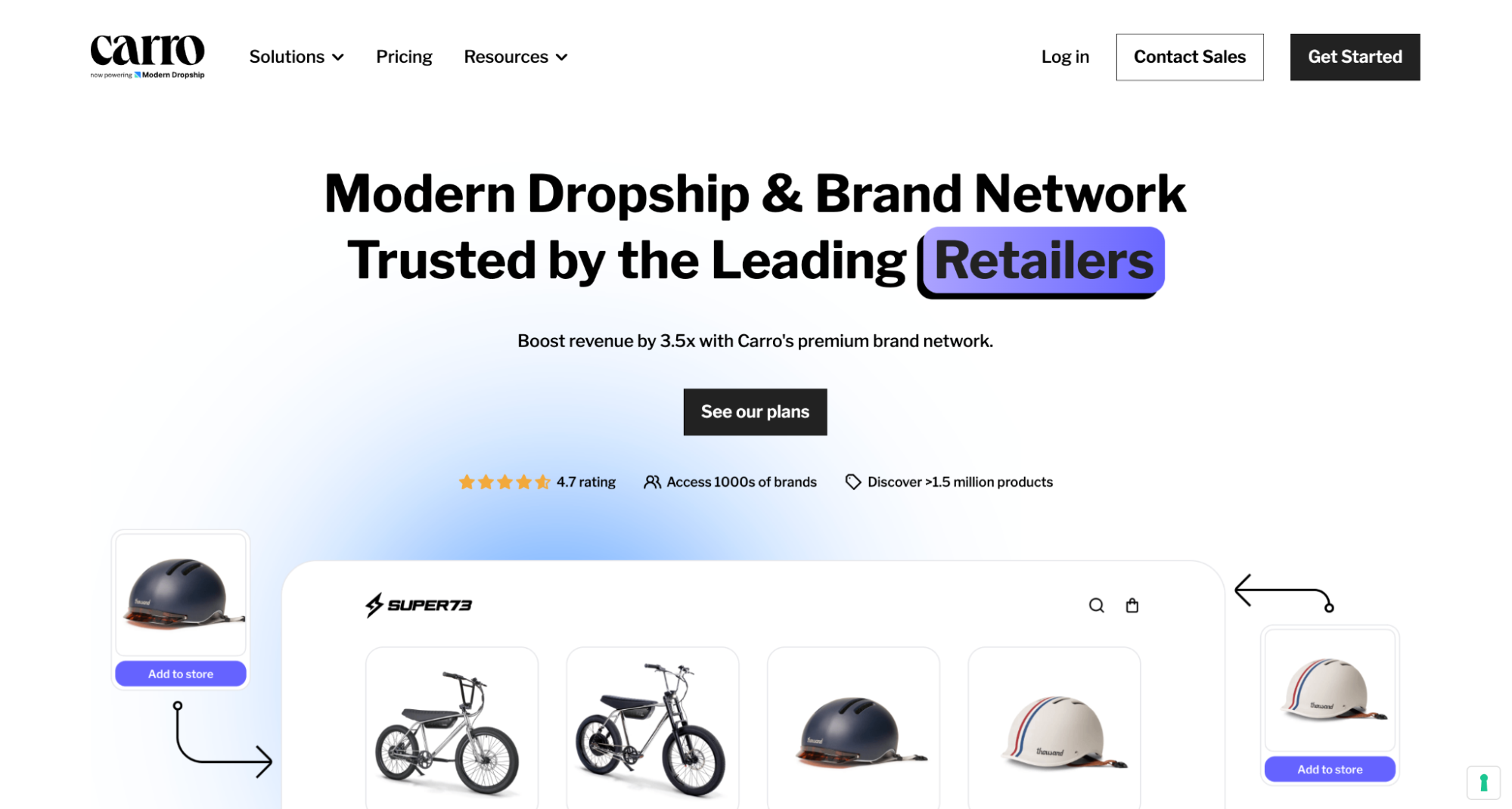
Carro (now powering Modern Dropship) completely redefines what inventory management means for a Shopify store. Instead of just helping you track the products you own, Carro gives you the power to sell products from thousands of vetted brands - without ever spending a dollar on inventory. It's a dropship platform built for modern, curated retail experiences.
Think of it as borrowing supply. Through Carro's vast network, you can browse and add complementary products to your store with just a few clicks. The product pages, descriptions, and images are synced instantly. When a customer buys one of these partner products, the order is automatically routed to the supplier brand, who ships it directly to the customer. You collect your profit, and the supplier gets a new sale.
It's the ultimate way to:
- Increase Average Order Value (AOV): Suggest relevant add-ons from partner brands to your existing customers.
- Test New Product Categories Risk-Free: Want to see if your audience would buy sustainable home goods? Add a few from a partner brand and find out without any upfront cost.
- Create a More Compelling Brand Experience: Curate a one-stop shop for your niche, offering a wider assortment of vetted products.
While traditional systems manage the liability of stock you own, Carro offers growth without the risk. It integrates seamlessly as a Shopify app, making setup and management effortless.
Key Features:
- Hand-Matched Supplier Network: Carro’s Account Managers connect retailers with complementary brands to ensure curated, high-demand products from trusted brands.
- Automated Order Routing: Orders for partner products are automatically sent to suppliers for fulfillment.
- Real-Time Sync & Integrations: Product information, pricing, and inventory are updated automatically. Supports Shopify, WooCommerce, BigCommerce, Magento, as well as EDI and SFTP connections.
- Seamless Catalog Expansion: Broadens your product range while simplifying the complexities of inventory management.
Who is it for?
Carro is the best inventory management software for Shopify for ambitious brands that want to grow revenue and expand their product catalog without the financial burden and risk of purchasing and holding physical inventory. It is perfect for stores focused on curation, partnerships, and smart, capital-efficient growth.
2. Cin7
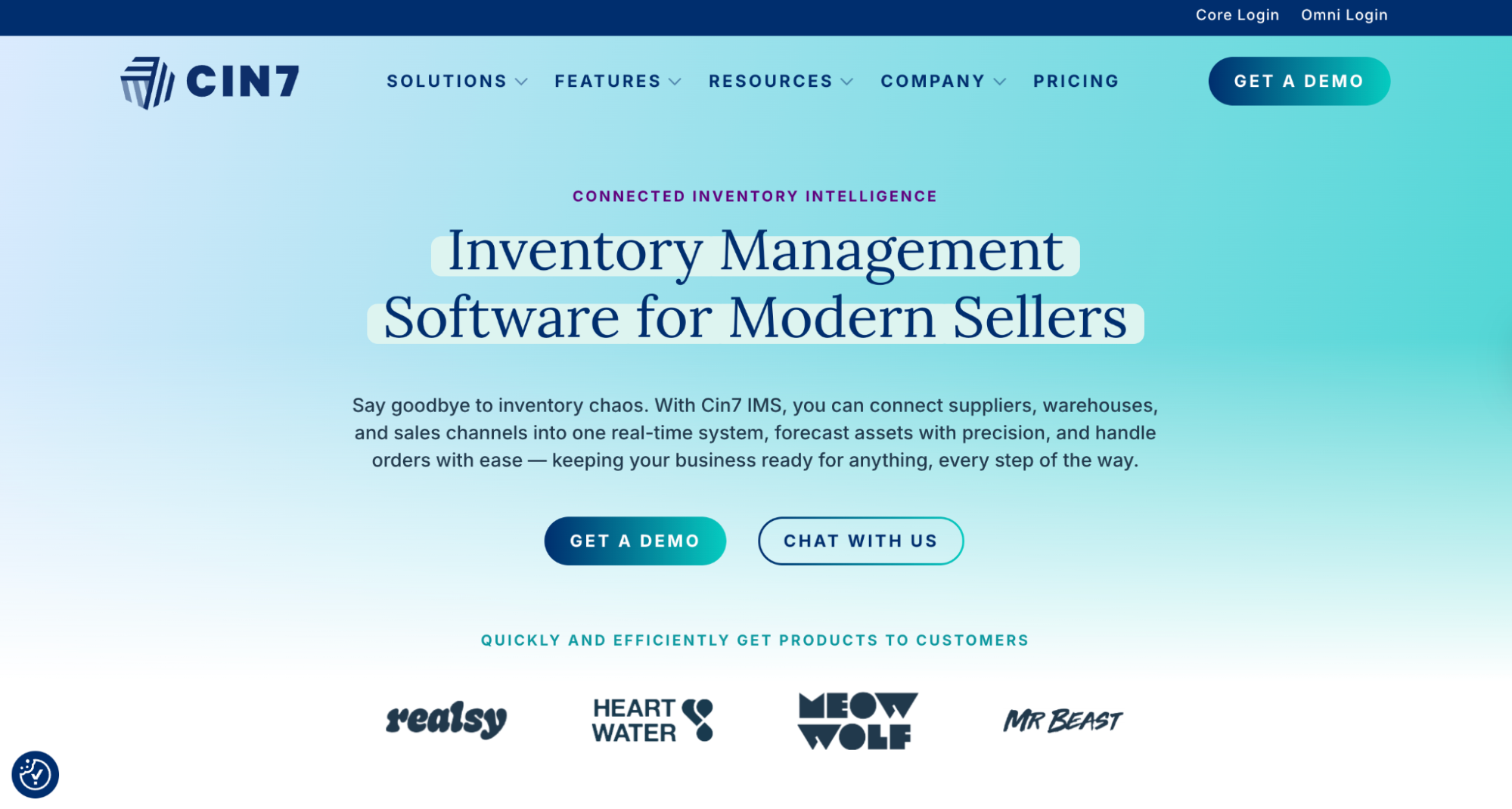
Cin7 is a heavyweight inventory management software for Shopify designed for brands operating at scale and across multiple channels. If you sell on Shopify, Amazon, in a physical retail store, and through a wholesale channel, Cin7 is built to unify them all. It provides a powerful, centralized hub for inventory, orders, and even your point-of-sale (POS) data.
The platform excels at automation. You can set up rules to route orders to the most efficient warehouse or 3PL, automate the creation of purchase orders when stock runs low, and sync data seamlessly with your accounting software. Cin7 also has robust features for B2B commerce, including custom pricing and a dedicated portal for wholesale customers.
While its power comes with a steeper learning curve and a higher price point, it’s a solution that established brands can grow into, not out of.
Key Features:
- Connected Multi-Channel Inventory: Real-time sync across all online and offline sales channels to prevent overselling.
- B2B and B2C Functionality: Manage wholesale and direct-to-consumer operations from a single platform.
- Built-in POS and EDI: Supports in-person sales and automates transactions with major retail partners.
- Advanced Reporting: Provides deep insights into sales velocity, channel profitability, and inventory aging.
Who is it for?
Established, high-volume retailers and wholesalers who need a powerful, automated system to manage the complexity of multi-channel commerce.
3. Katana
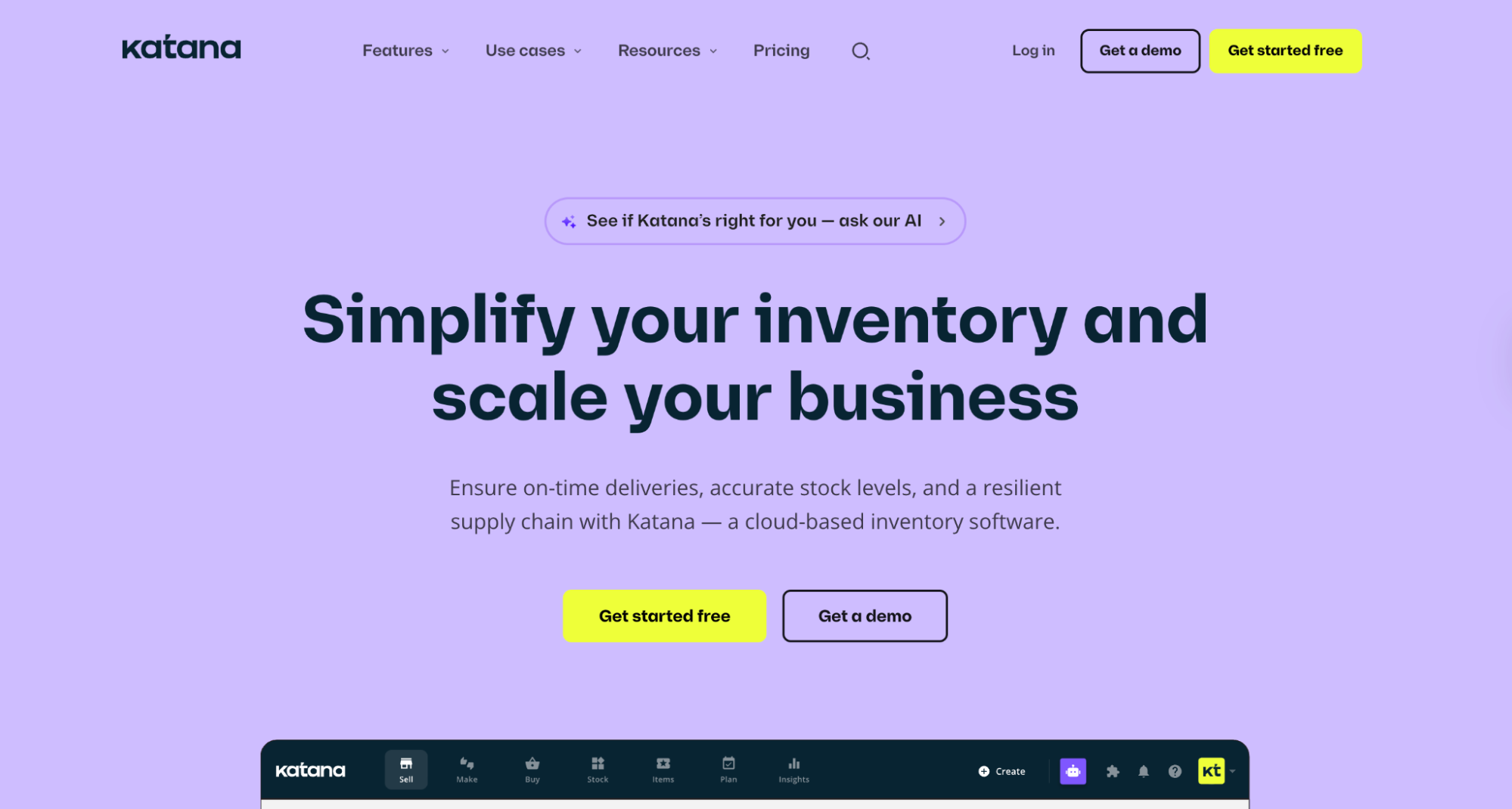
While many inventory tools are built for resellers, Katana is designed specifically for makers. If your brand manufactures or assembles its own products, Katana is the "manufacturing ERP" that gives you total control over your production process, from raw materials to finished goods.
Katana's standout features include its bill of materials (BOM) and production planning capabilities. You can define the "recipes" for your products, track raw material stock levels, and automatically generate manufacturing orders based on sales demand. This "live" view of your inventory means you know exactly what you can produce and when, ensuring you never promise a customer a product you can't make.
It integrates directly with Shopify, so sales orders automatically inform your production schedule. This connection between your sales floor and your shop floor is invaluable for scaling a D2C manufacturing business.
Key Features:
- Live Inventory Management: Track raw materials, work-in-progress, and finished goods in real time.
- Bill of Materials (BOM): Create detailed product recipes to accurately track costs and component inventory.
- Visual Production Planning: A color-coded dashboard makes it easy to prioritize and track manufacturing orders.
- Floor-Level Control: A shop floor app allows your production team to manage tasks and track time without needing full access to the system.
Who is it for?
Direct-to-consumer (D2C) brands on Shopify that manufacture or assemble their own products, such as jewelry, apparel, food and beverage, or custom furniture.
4. SkuVault
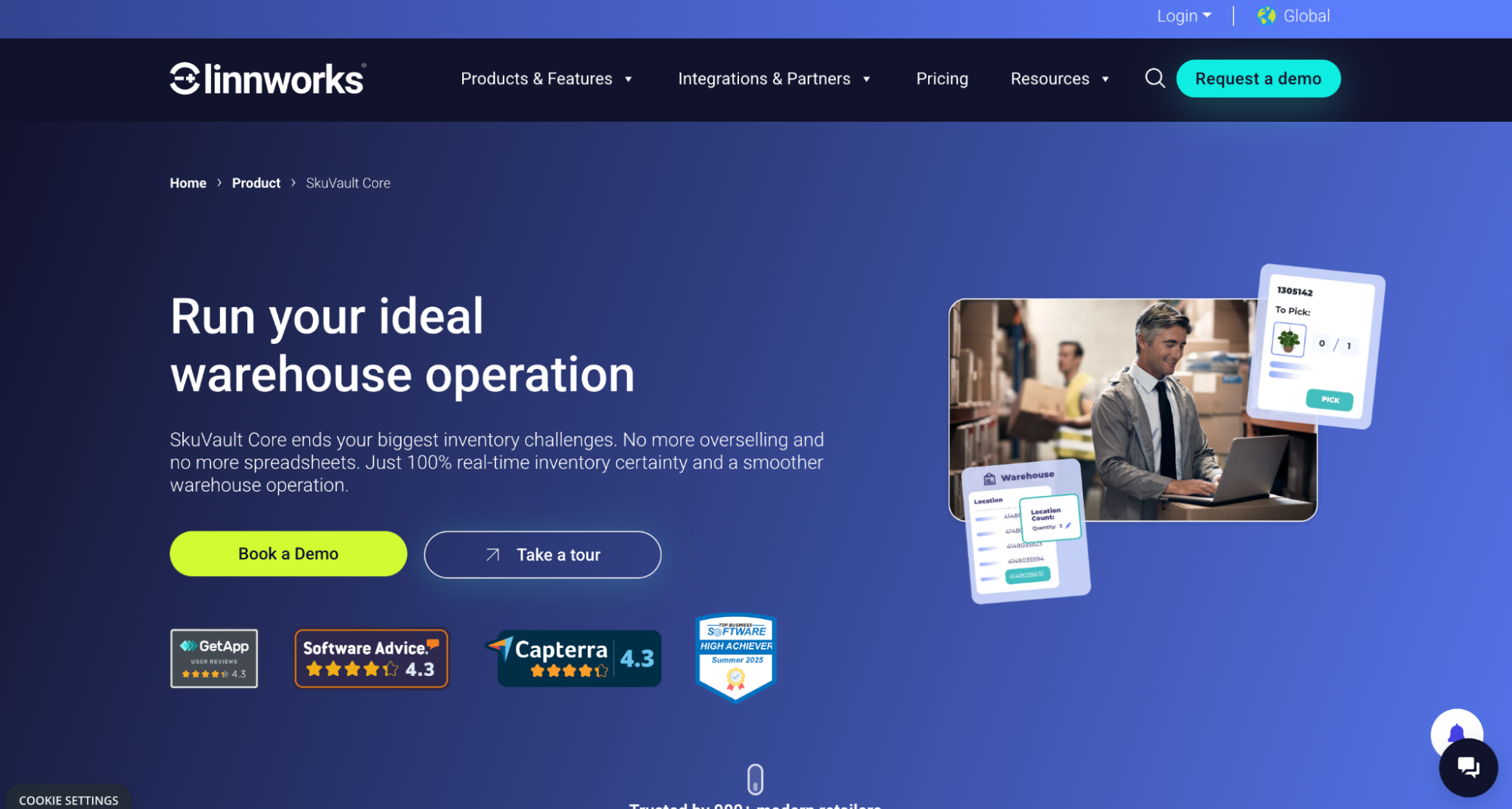
SkuVault is an inventory and warehouse management system (WMS) built for one primary purpose: eliminating fulfillment errors and increasing warehouse efficiency. While it offers robust inventory tracking, its true strength lies in its powerful tools for managing the physical movement of goods within your warehouse.
Features like interactive wave picking, quality control checks, and hyper-accurate barcode scanning are designed to streamline the pick, pack, and ship process. SkuVault helps prevent costly mis-ships, reduces inventory shrinkage, and gives you a precise, auditable trail for every item in your facility. Its reporting is also top-notch, providing data on everything from picker performance to inventory turnover.
For brands that have outgrown simple inventory tracking and are struggling with fulfillment mistakes as order volume grows, SkuVault provides the structure and control needed to scale operations efficiently.
Key Features:
- Error-Reduction Focus: Features are designed to prevent common warehouse mistakes like mis-picks and incorrect quantities.
- Advanced Barcoding and Location Tracking: Use barcodes for everything from receiving to cycle counts, with detailed location tracking (aisle, shelf, bin).
- Intelligent Picking Routes: Create optimized picking paths (wave picking) to fulfill multiple orders at once, saving time and labor.
- Powerful User Permissions: Control exactly what each member of your warehouse team can see and do.
Who is it for?
High-volume Shopify merchants with their own warehouse operations who need a robust WMS to reduce fulfillment errors, increase efficiency, and gain tight control over their physical inventory.
5. Stocky
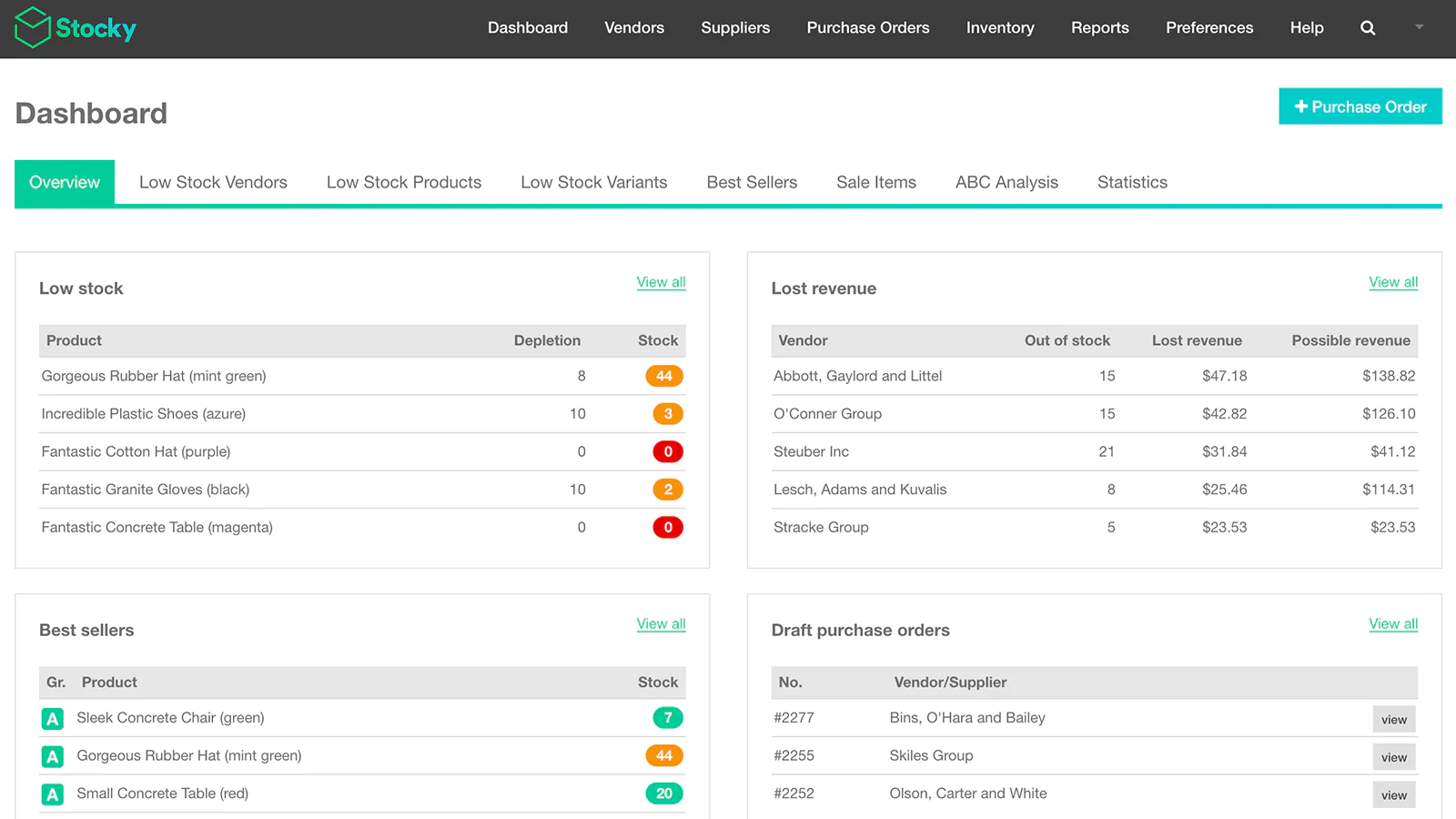
For merchants just starting or those who primarily sell through a physical location using Shopify POS, Stocky is an excellent entry point into inventory management. Developed by Shopify, it's included for free with the Shopify POS Pro subscription.
Stocky covers the essentials well. It helps you create and manage purchase orders, receive stock, and get recommendations on what to reorder based on recent sales performance. Its barcode scanning functionality allows you to perform stocktakes quickly with a mobile device. While it lacks the multi-channel syncing capabilities and advanced automation of paid platforms, it’s a significant step up from a spreadsheet.
Because it's a Shopify product, the integration is seamless and the interface is familiar. It’s the perfect tool for getting your basic inventory processes in order before you need a more powerful, specialized solution.
Key Features:
- Purchase Order Management: Create, send, and receive purchase orders directly within the app.
- Demand Forecasting: Get simple reorder suggestions based on your sales velocity.
- Stocktakes and Transfers: Use a barcode scanner for quick inventory counts and manage transfers between locations.
- Free with Shopify POS Pro: A cost-effective solution for merchants already using Shopify's professional point-of-sale system.
Who is it for?
New Shopify merchants or brick-and-mortar retailers using Shopify POS Pro who need a simple, free tool for purchase orders, stocktakes, and basic inventory analysis.
6. SKULabs
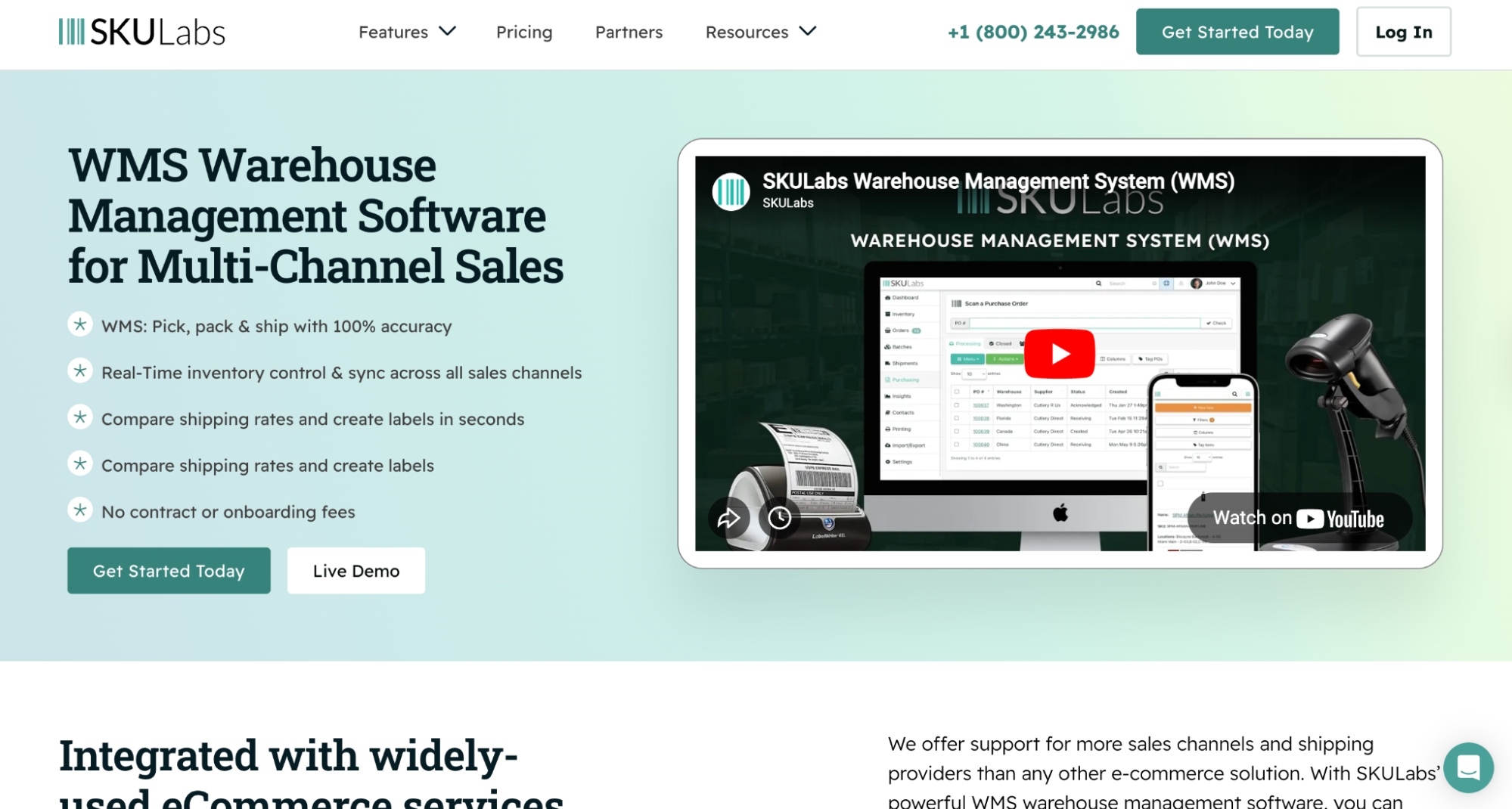
SKULabs is designed for growing brands that want to manage their entire fulfillment workflow - from inventory to the shipping label - in one place. It combines inventory management, barcoding, and multi-carrier shipping into a single, unified platform. This prevents the need to stitch together separate systems for inventory and shipping, which can often lead to data discrepancies.
With SKULabs, you can track inventory across multiple warehouses and channels, use barcode scanners to pick and pack orders with 100% accuracy, and then shop for the best shipping rates across all major carriers without leaving the interface. This all-in-one approach streamlines your back-end operations and ensures that what's on your shelf perfectly matches what's in your system and what's on the shipping label.
Key Features:
- Unified Platform: Manages inventory, order picking, and shipping label generation in one system.
- Multi-Carrier Shipping: Compare rates and print labels for dozens of carriers without exporting data.
- Barcode-Driven Workflows: Enforce barcode scans at every step of the fulfillment process to eliminate errors.
- Lot and Serial Number Tracking: Provides full traceability for products that require it, such as electronics or supplements.
Who is it for?
Growing ecommerce brands that manage their own fulfillment and want a single platform to control inventory, streamline warehouse picking, and optimize shipping costs.
What is Collaborative Commerce? A Smarter Way to Manage Inventory
Traditional inventory models require retailers to buy, store, and manage stock before knowing what will sell. This ties up capital, increases risk, and limits how quickly assortments can expand.
Collaborative commerce, powered by Carro, enables retailers to sell from partner held inventory without purchasing or holding stock, while maintaining control over margins, customer experience, and brand relationships.
This is not a catalog marketplace. Retailers can bring their own brand and distributor relationships onto Carro, while the Modern Dropship powered by Carro team provides hands on matchmaking to connect the right partners based on category fit and operational readiness.
How It Works
Retailers onboard existing partners or work with the Carro team to identify complementary brands and distributors. Product data, pricing, and inventory sync directly into the retailer’s store through Shopify or API.
When an order is placed, it is automatically routed to the partner for fulfillment. The supplier ships directly to the customer, while Carro keeps inventory, order status, and settlement in sync.
The result is growth without inventory liability and expansion without operational complexity, allowing retailers to focus on curation, speed, and customer experience.
Essential Features of Inventory Management Software for Shopify
- Purpose driven partner enablement with guided matchmaking
- Real time product and inventory syncing
- Automated order routing and fulfillment
- Flexible commercial and payment models
- Native Shopify integration with API support
Collaborative commerce is built for retailers who want to expand assortment and revenue without owning inventory, while staying agile in an ever evolving market of tastemakers.
The Dangers of Using Spreadsheets for Inventory Management
Many brands start with a Google Sheet or Excel file to track inventory. It's free and seems simple enough.
However, as you grow, that spreadsheet quickly becomes your biggest liability:
- They Don't Update in Real Time: A spreadsheet is a static document. When an item sells on Shopify, someone has to manually update the sheet. If you sell on multiple channels, this becomes impossible to manage, leading directly to overselling and angry customers.
- They Are a Breeding Ground for Human Error: A single typo, a misplaced decimal, or a copy-paste mistake can throw your entire inventory count into chaos. These errors lead to poor purchasing decisions, unexpected stockouts, and financial losses.
- They Lack Automation and Waste Time: You and your team will spend countless hours manually updating stock levels, creating purchase orders, and trying to figure out what to order next. This is low-value work that prevents you from focusing on marketing, customer service, and business growth.
- They Offer Zero Actionable Insights: It's incredibly difficult to analyze sales trends, calculate inventory turnover, or determine product profitability from a spreadsheet. You're essentially flying blind, making decisions based on guesswork rather than data.
Upgrading to a dedicated inventory management software for Shopify is one of the highest-ROI decisions a growing brand can make. It replaces chaos with control, guesswork with data, and manual labor with automation.
How to Choose the Right Inventory System for Your Shopify Store
Selecting the right software can feel overwhelming, but you can narrow down the choices by focusing on your specific needs.
Step 1: Analyze Your Business Model.
Resellers need strong multi-channel syncing and purchase order management. Makers should choose platforms with BOM and production planning, like Katana. To expand your catalog risk-free, Carro’s collaborative commerce model is ideal. For large, complex warehouses, a WMS-focused platform like SkuVault is a must.
Step 2: Evaluate Your Current Scale and Future Goals.
Where are you now, and where do you want to be in two years? Choose a solution that fits your current order volume but has a clear path to scale with you. Don't pick a basic tool if you're planning aggressive expansion.
Step 3: Map Your Entire Technology Stack.
Make a list of every software you rely on: Shopify, your accounting platform, shipping apps, email marketing tools, and any 3PLs. Your chosen inventory system must integrate with this stack to avoid creating data silos and manual workarounds.
Step 4: Set a Realistic Budget Based on Value, Not Just Price.
While cost is a factor, focus on the return on investment. The best inventory management for Shopify will pay for itself many times over by preventing lost sales from stockouts, reducing carrying costs from overstock, and saving hundreds of hours of manual work. A cheap solution that doesn't solve your core problems is more expensive in the long run.
Take Control of Your Inventory with Carro
Inventory should be a growth lever, not a constraint. Carro gives retailers a new way to expand assortment without tying up capital or taking on inventory risk.
Instead of relying only on owned stock, retailers can activate their existing brand and distributor relationships or work directly with the Carro team for hands-on matchmaking. Products sync seamlessly into your store through Shopify or API, while partners fulfill orders directly to the customer.
With Carro, you can:
- Expand assortment without purchasing or holding inventory
- Increase revenue and AOV through better curation
- Leverage your own supplier relationships with built in infrastructure
- Automate order routing, fulfillment, and settlement
- Maintain control of the customer experience and margins
Stop managing inventory liability. Start managing relationships, selection, and growth.
Frequently Asked Questions (FAQs)
What is an inventory management software for Shopify?
Inventory management software for Shopify helps store owners track and manage product inventory directly within the platform. It automates tasks like inventory updates, order tracking, and restocking reminders to prevent overselling and stockouts. Features like real-time syncing save time, reduce errors, and support business growth.
What is the best inventory management software for Shopify?
For Shopify businesses aiming for growth and cost efficiency, Carro is the best inventory management software. It lets you expand your product range and increase revenue without the financial risk or hassle of managing inventory. For businesses producing their own products, Katana is another great option.
Does Shopify have built-in inventory management?
Yes, Shopify has basic inventory management features built-in. You can track quantities, and it will stop sales when an item's stock reaches zero. For more advanced features you would need an app like Stocky (free with Shopify POS Pro) or a more powerful third-party platform like Carro.
What is the difference between inventory management and a WMS?
An Inventory Management System (IMS) focuses on the "what" and "how much" - tracking stock levels, syncing quantities across channels, forecasting demand, and managing purchase orders. A Warehouse Management System (WMS) focuses on the "where" and "how" - optimizing the physical operations within a warehouse, such as bin locations, picking paths, and packing workflows. Platforms like SkuVault are more WMS-focused, while others like Cin7 combine elements of both.
How does dropship inventory management work?
Dropship inventory management replaces owned stock with real-time connections to your supplier and brand partners. Instead of tracking products in a warehouse, your store stays automatically synced to your partners’ available inventory, ensuring you only sell what can actually be fulfilled.
Modern Dropship powered by Carro goes a step further by enabling collaborative commerce. Retailers bring their own brand and distributor relationships or work with the Carro team for hands-on matchmaking. Product data, availability, and pricing stay continuously updated, while orders route directly to the partner responsible for fulfillment.
The result is accurate inventory, fewer operational headaches, and the ability to scale assortment without taking on inventory risk.


Related Posts
.png)
.png)
.png)
